

Edward Snowden: The man whose revelations about state surveillance changed the world speaks exclusively to the Guardian about his new life and his worries about the future
The world's most famous whistleblower, Edward Snowden, says he has noticed that his public image in the US is not facing as much hostility as when he revealed top-secret documents that revealed global surveillance programs conducted by American and British intelligence agencies.
In an exclusive two-day interview in Moscow to mark the publication of his memoir, Permanent Record, Snowden recalled the warnings he received that his revelations would cause damage. He is still feeling the cost, of course, but even his former critics admitted that “we live in a better, safer world” because of his revelations.
In the book, Snowden details for the first time his background and what led him to leak details of secret programs run by the US National Security Agency (NSA) and the UK's secret communications headquarters, GCHQ.
He describes the 18 years since the September 11 attacks as “a litany of American destruction through American self-destruction, with the publication of secret policies, secret laws, secret courts and secret wars.”.

In an exclusive two-day interview in Moscow to mark the publication of his memoir, Permanent Record, Snowden recalled the difficult times and the warnings he received that his revelations would cause serious damage. He is still feeling the cost, of course, but even his initial critics have admitted that “we live in a better, safer world” because of his revelations.
In his book, Snowden details for the first time his background that led him to leak details of the secret programs of the US National Security Agency (NSA) and the UK's secret intelligence agency, GCHQ.
He describes the 18 years since the September 11 attacks as “a litany of American destruction with the adoption of secret laws, the holding of secret courts and secret wars.”.
Snowden also said: “The greatest danger still exists, with the improvement of artificial intelligence capabilities, such as facial and pattern recognition.
Watch the Guardian's exclusive video interview with Edward Snowden.
He is concerned that the US and other governments, with the help of major internet companies, are moving towards creating a permanent record of all people on earth, recording their entire daily lives.
Snowden appears to have justified himself for what he did six years ago, telling the Guardian that he had come to terms with living in Russia and planned his future on that basis.
He discovered that he secretly married his girlfriend Lindsay Mills two years ago in a Russian courtroom.
Of course, he would prefer to be in the US or somewhere in Germany, where the regime is more relaxed than in Russia. He says he is less afraid since he first arrived in 2013 and recalled feeling lonely, isolated and quite paranoid, since he constantly saw American agents on the streets.

Today, she has abandoned the scarves, hats, and coats she once used as a disguise and moves freely around the city, using the subway, visiting art galleries or going to ballet, and meeting friends in cafes and restaurants.
His book Permanent Record, which is published on Tuesday in more than 20 countries, documents what led him to take secret NSA and CIA documents to Hong Kong, where he handed them over to Guardian journalists.
A surveillance camera equipped with AI will not be a simple recording device, but an automated police officer.
These documents revealed the extent of mass surveillance by the US, the UK and their allies. His name is high on the US wanted list and he faces decades in prison if caught.
The US government could get royalties from sales of the book, but a significant amount has already been deposited.
In the discussion about his personal life, Snowden spoke for the first time about his life in Moscow and about the man he calls "the love of my life.".
Polls conducted in the US in 2013 and those that followed in the years immediately following showed a split in public opinion. Half of them considered him a traitor and the other half a hero.
It's funny that now, six years later, the controversial image I had is starting to take shape
Even people who personally dislike him are now ready to accept that “we live in a better, freer and safer world because of the revelations of mass surveillance,” he said in the interview.
One of the Democratic presidential candidates, Bernie Sanders, said he would like to see a resolution that would stop Snowden's permanent exile, while another, Congresswoman Tulsi Gabbard, said in May that she would pardon him.
His fear that President Vladimir Putin would hand him over as a gift to Donald Trump has passed as relations between the US and Russia are not that close.
According to Snowden, we live in a society in which we are forced to live our lives naked in the eyes of power.
To address this, he argues that both legislative reform and increased use of end-to-end encryption to protect electronic communications are needed. However, these are not enough to address the accelerating technological changes that allow greater invasions of privacy, and he calls for a global protest movement similar to that of climate change.
You have to be ready to fight for something if you want it to change, the book I believe will help people decide for themselves.
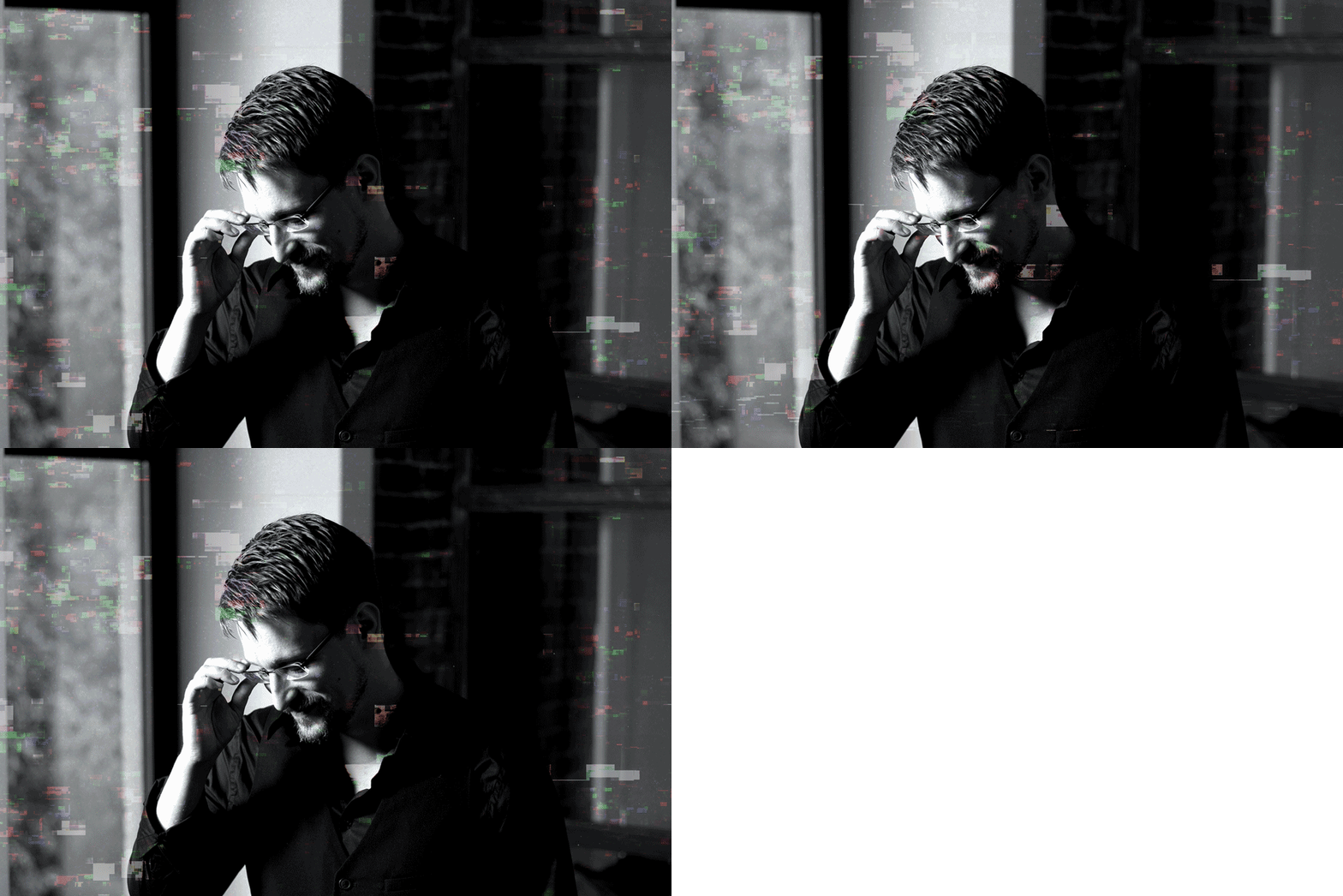
Edward Snowden, now 36, lives in a two-bedroom apartment on the outskirts of Moscow, earning his living mainly from speaking to students, civil rights activists and others abroad via video links.
He renewed the temporary asylum he received the first time around and now has permanent residency, acquiring the equivalent of a U.S. green card. The card is renewed every three years, although as the matter stands it is merely procedural.
He loves to travel, and despite being confined to the borders of Russia, he has visited cities such as St. Petersburg and the Black Sea resort of Sochi.
One of the things that gets lost with all the problematic policies of the Russian government is the fact that this is one of the most beautiful countries in the world. The people are friendly and warm.
And when I came here, I didn't understand it. I was terrified of the place because it was the enemy's big fortress, which is the way a CIA agent sees Russia.
In the past, he would not have spoken openly so warmly about Russia, worried about how it might be perceived in the US.
Edward Snowden says that exile did not mean his complete severance from society, “a punishment worse than death.” He could now communicate with students in New York via video, and three hours later he did the same thing in Germany.
Describing himself as “a house cat by choice,” he is happy to sit late at night at his computer, communicating with activists and supporters. The time difference with the US has made staying up late a necessity.
In his book Permanent Record, he describes how he and Mills met when they were 22 on an online site, Hot or Not, where they posted their photos and rated them. He gave her a 10 out of 10 and he gave him an eight.
Seven years later, as he prepared to fly to Hong Kong, he didn't mention anything to her about his decision to become a whistleblower.
One of the surprises in Permanent Record is the inclusion of excerpts from her diary. They are harsh and raw, detailing how upset she was by his sudden disappearance, but also paranoia as she wondered if he was having another affair.
When he arrived at Edward Snowden's door in Moscow, he expected him to slap him. But he hugged him and told him that he loved him and supported his decision to become a whistleblower.
You have to be ready to fight for something if you want to change it.
In his memoir, he writes about his childhood and teenage obsession with computers and certain games, such as Legend of Zelda and Super Mario Bros. As a teenager, he broke into a nuclear facility and reported its vulnerabilities to the authorities. An employee from the Los Alamos nuclear laboratory, where the atomic bomb was created, called his mother to thank him.

The Permanent Record provides many details about how an intelligence agency operates in the 21st century.
“There are no James Bonds.” He reports that the NSA is increasingly using outside contractors instead of employing permanent staff.
There was a crucial moment when he decided to become a whistleblower. He happened to be attending a conference on the scale of Chinese surveillance. This gave him the outrageous thought that if China does it, why shouldn't the US do it too. He looked it up and confirmed it.
Oliver Stone's 2016 film shows Snowden hiding classified NSA documents on an SD card inside a Rubik's Cube. Edward Snowden neither confirms nor denies this, knowing he could face criminal prosecution.
• The Permanent Record was published by Henry Holt and Company.
