

SecNews, always present in technological news and achievements, analyzes the events of September 18,2013 , concerning the murder of Pavlos Fyssas, based on the extensive analysis of Forensic Architecture, with its own technological perspective.
The Fyssa family assigned this highly experienced team to examine the audio-visual material of the case file for further analysis. The research center proceeded to a spatial and temporal analysis of the events preceding the murder in order to accurately assign the position of those involved in it and thus answer many unanswered questions.
After examining the available material, it was found that almost none of the video files included accurate metadata and it appears that the security cameras had not been properly configured by their owners. This fact, combined with the unclear methodology followed until the involvement of Forensic Architecture, characterizes the reports that had been filed previously as incomplete.
The proper exploitation and management of available resources in order to define an accurate time frame of events is a key point of analysis and this is reflected in the work of Forensic Architecture.
To conduct the investigation, Forensic Architecture initially had to define the exact field of view for each security camera that recorded events related to the incident. To make this possible, it was necessary to study the available material in the light of a map and photographs of the area. Its capture in a three-dimensional environment was done with the help of Google Earth, Google Maps as well as on-site study and the software used were Rhinoceros 5.0 and 3D Studio Max. The analysis of the video files was done with the video editing software Adobe Premiere Pro and Adobe After Effects.
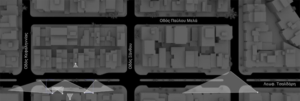
To achieve the necessary synchronization of the visual material, the research team defined and observed “reference points” through multiple cameras. For example, the movement of pedestrians with a steady gait and the movement of cars on Tsaldari Street were observed as they crossed the said cameras. Subsequently, the video files were synchronized by calculating the average speed of the moving bodies.
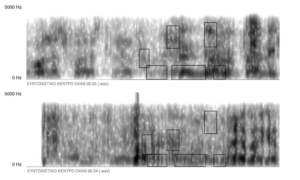
After all the visual material at the team's disposal was synchronized and digitally captured, the next step was the synchronization and analysis of the audio sources from the EKAB and police transmissions, as these conversations carry a precise time stamp. As mentioned above, it was found that the video footage did not include the correct time stamps, so correlating the audio sources with it was a crucial point in the investigation for defining the time frame of the events of that evening with an accuracy of a second. Adobe Premiere Pro and Adobe Audition were used for the synchronization of the audio files, while Praat software was used for the voice analysis.
After processing and examining the above audiovisual material, the following irrefutable conclusions emerge:
- At 23:58:11, the four motorcycles of the DIAS team are seen arriving in the area. The police officers themselves testified that they had not received the call for intervention from the headquarters until 23:59.
- The video clearly shows that four motorcycles arrived: that is, two teams, each of two motorcycles. However, the head of the Keratsini Police Department team, Anastasios Tsolakidis, approximately 3 minutes later at 00:01:26, stated on the radio that only one team was at the scene.
- At 23:59:08, a convoy of 8 motorcycles arrives, followed by two cars. The first vehicle matches the description of George Roupakias' car (a silver Nissan Almera).
- A few seconds later, at 23:59:40, the motorcycles of the DI.AS. teams reappeared on Tsaldari Street, from the direction of Xanthou Street heading towards Kefallinias Street. The motorcycles therefore appear to have circled the building block. This turn is not included in any of the police statements.
- At 00:01:49, people are seen running on Tsaldari Street and turning east onto Xanthou Street. Based on the witness statements, it is estimated that these people were friends of Pavlos Fyssas.
- At 00:02:10, a car matching the description of George Roupakias' car (a silver Nissan Almera) is seen. At 00:02:17, the driver of the car in question, believed to be George Roupakias, is seen exiting his vehicle, which had been temporarily parked on Xanthou Street, and looking towards the crime scene. The driver then re-entered the car and at 00:03:00 he reversed and entered Tsaldari Street against the flow of traffic.
- According to the analysis of the movement of the above car and the mobility of the people at the crime scene (as they appear faintly as figures in the depth of the camera's field of view), the murder of Pavlos Fyssas is estimated to have taken place between 00:03:23 and 00:04:06.
- Within the time frame of the murder, at 00:03:35, the head of the Keratsini Police Department team transmitted to the Police Department Operations Center that an attempt was being made to separate the individuals.
- At 00:04:06, four figures are seen quickly leaving the scene.
- At 00:05:20, the head of the DIAS Keratsini team, Anastasios Tsolakidis, transmitted to the DIAS Operations Center that Pavlos Fyssas had been injured. A call to the EKAB had been made at around 00:04 (without time stamp), from Christos Deligiannis' personal mobile phone.
Forensic Architecture 's research clearly demonstrates that expertise combined with the appropriate use of technological means can be a catalytic factor in the investigation and detection of criminal acts. More and more court cases include the analysis of digital evidence. A properly structured investigation, such as the Forensic Architecture investigation into the murder of Pavlos Fyssas, constitutes unshakable evidence in the hands of justice. Such an investigation, so analytical, without leaving any question mark as to its accuracy and correctness, can fully determine the outcome of a court case. This finding can act as a deterrent to similar actions in the future but also a valuable tool in the hands of justice.
