

China appears to be planning a space mission to the far side of the moon. The China National Space Administration (CNSA) plans to launch Chang'e 4, which will carry the country's second lunar rover, in 2020.
According to recent comments made by Wu Weiren, chief engineer of the lunar exploration program, the rover will explore the "dark" side of the moon that is not visible from Earth.
Although China began launching satellites in the 1970s, the country's space agency has made much greater progress since 2000, becoming the third country to send astronauts into space in 2003.
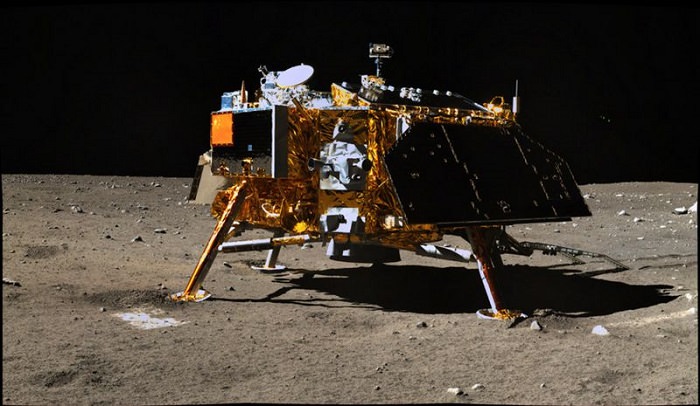
In 2007, CNSA sent its first spacecraft (named Chang'e 1, after the Chinese moon goddess) into lunar orbit. It was followed by the Chang'e 2 orbiter in 2010 and Chang'e 3 in 2013. The latter also carried a small rover (named Yutu) to the moon. However, mechanical problems prevented the rover from traveling more than 100 meters on the moon.
Subsequent missions will go even further. Chang'e 5 will collect rock samples and bring them back to Earth.
Plans for the launch of Chang'e 4 in 2020 again include carrying a rover, as with Chang'e 3.
If all goes according to plan, the new rover will be able to gather much more data and perhaps explore the far side of the moon.
Because the moon revolves around the Earth at the same speed as the Earth rotates, we constantly see the same side.
Thus, we know much less about the unseen side of the moon (we call it the "dark side", although it is not, because we may not see it, but the sun "sees" it constantly) because there is no direct visual contact.
But why is China so interested in exploring the far side of the moon?
China is interested in taking samples with the aim of discovering a helium isotope called helium-3. This isotope could one day be used to make nuclear weapons or generate energy.
The helium isotope helium-3 appears to be much more abundant on the moon than on Earth, where it is extremely rare. The far side of the moon is thought to have the highest concentrations because it is exposed to a lot of solar winds, which essentially produce helium-3.
It is not certain that this is China's goal. To collect the necessary quantities of helium-3 it needs, it will also have to prepare Chang'e 5. CNSA, meanwhile, has never openly stated that it plans to mine the helium-3 isotope.
The article was published on VOX.
