

 Researchers at the American company IBM have for the first time successfully transmitted a short radio signal (the three letters of their company's name) to a pioneering receiver chip containing transistors made from the new "miracle" material, graphene. The achievement, although still in its early stages, paves the way for a future revolution in wireless communications.
Graphene, one of the thinnest electronic nanomaterials, is seen as promising for a wide range of practical applications, from flexible displays to high-speed integrated circuits. But until now, wireless circuits, such as those found in Bluetooth and Wi-Fi, have not been able to be built with graphene transistors because it is technically difficult - because graphene is easily damaged - to combine the delicate graphene transistors with the other necessary metal components of a circuit, such as resistors and inductors, on the same chip.
This difficulty has now been overcome by simply reversing the usual manufacturing process, namely placing the metal elements on the chip first and then the transistors. Thus, researchers at IBM's Watson Research Center in New York, who published the relevant publication in the journal "Nature Communications", according to "New Scientist", announced that they had created the world's most advanced and fully functional integrated circuit (chip) made of graphene, which has a performance 10,000 times better than any other previous attempt.
Such chips could make wireless devices (tablets, smartphones, etc.) much faster - and cheaper - in the future, while giving them new capabilities that are not possible with today's silicon chips. The researchers point out the possibility of seamless integration of graphene chips into existing silicon-based electronic technology, as the graphene chip "steps" on a conventional silicon wafer, so the existing production lines of chip manufacturing industries will not need to be significantly modified.
Graphene, discovered about a decade ago (and awarded its creators a Nobel Prize), is made up of flat sheets of carbon just one atom thick, arranged in a hexagonal honeycomb pattern. The new material has unusual electrical, optical, thermal and mechanical properties, making it suitable for wireless communications.
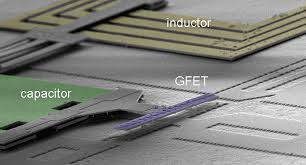
The signal "I-B-M" (a three-letter digital text) was transmitted at a radio frequency of 4.3 GHz without any loss or distortion. The integrated circuit consists of three graphene transistors, four inductors, two capacitors and two resistors. All these components of the "chip" are located on an area of 0.6 square millimeters. In addition, thanks to the high conductivity of graphene as a material, the new circuit uses less electricity than conventional radio chips.
IBM's research was funded by the US Pentagon's ubiquitous Defense Advanced Research Projects Agency (DARPA), the agency that essentially started the creation of the Internet and "sees" potential military applications everywhere.
However, according to estimates by other (competing) researchers, although the new achievement is indeed impressive, it will take at least 20 years before these "hybrid" graphene-silicon chips are adopted on a mass scale.
