


VDI Virtual Desktop Infrastructure: Real solution – virtual management
The ever-increasing needs of businesses for remote and simultaneously secure access to corporate data has led several companies to implement virtual workstation infrastructure solutions known as Virtual Desktop Infrastructure (VDI).
Review and operation
VDI technologies have been on the market for at least a decade, with major vendors such as Citrix, VMware and Microsoft providing similar services. They are intelligent endpoint solutions that provide full oversight and control to administrators, while providing a familiar and user-friendly environment.
More specifically, VDI solutions are a variation of the classic server-based model, replacing physical clients with virtual ones, which in turn are hosted on a central server. Workstations are installed on physical servers, on which virtual desktops (workstations) are created and share the resources of the physical machine (server).
Because these are centralized services, users have the ability to access their workstations from any location, without being tied to a specific device, while maintaining uniformity in applications and data. Of course, for administrators, the nature of centralized services provides a breath of more effective management, increasing the ability to respond to user needs with the aim of the smooth operation of the business, since the workstations are installed on the server which is located within the security of the corporate data center.
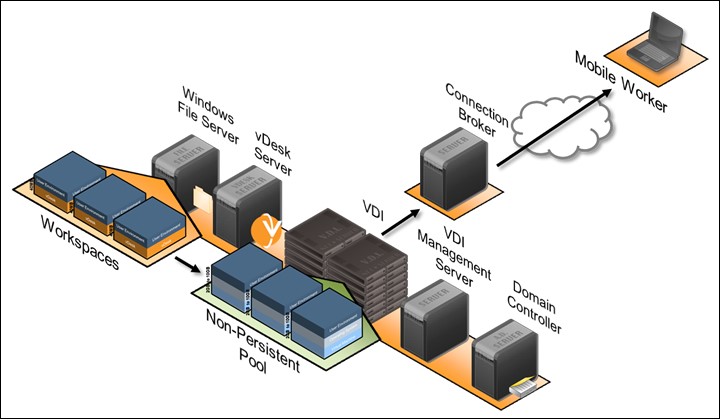
In VDI models, servers and endpoints are treated more as services and less as hardware, supporting the needs of corporate infrastructure from a different perspective.
Infrastructure – application requirements
For the adequate use of VDI services, we need at least a virtualization solution in the backend independent of the vendor and of course a solution for users to access their virtual terminals (Virtual Machine – VM).
VDI technologies have not come to replace or even crowd out the traditional desktops that we all know and use.
The question that can reasonably arise is why, beyond the economic factor of a complete infrastructure upgrade, the current order of things regarding traditional workstations cannot be replaced with VDI solutions. And even more specifically, why cannot all the applications used by users be installed in the data center and provided to users via VM.
To answer these reasonable questions, we must take into account both the needs of users and the requirements of applications in terms of information resources.
Initially, we should consider how to deal with users who, for example, are traveling by air and while in offline mode wish to use their applications. In this case, it is not possible to connect to the user's digital terminal since the connectivity of the respective system is a necessary condition, as a result of which the user can only work locally. Certain applications, on the other hand, absorb a large volume of network resources for their effective operation, such as design programs with 3D visualizations, etc., which can typically result in reduced server functionality for the digital terminals connected to it. However, there are traffic control solutions that are implemented in VDI infrastructures. There are also certain applications that do not operate effectively through specific protocols such as RDP (Remote Display Protocol) and ICA (Independent Computing Architecture).
Therefore, a comprehensive VDI proposal should never exclude the participation of at least some traditional workstations, of course having the necessary protection measures imposed by the corporate security and smooth operation policy.
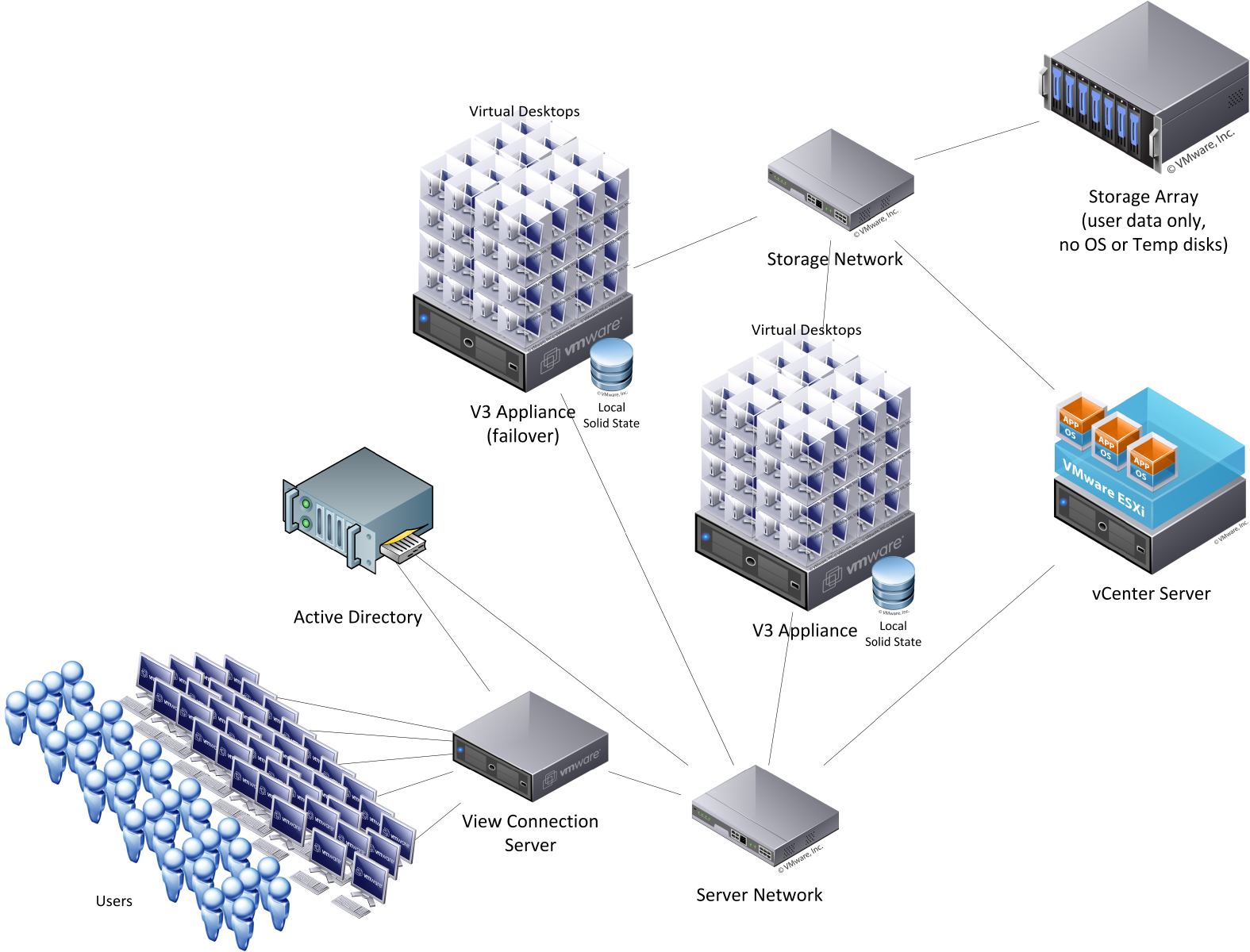
An equally important issue in the effective adoption of VDI services is the understanding by administrators of how to manage such a network and how to manage its resources, with all that this entails.
Advantages – Business benefits
The lure for businesses in adopting VDI services is the relative savings in resources through the adoption of a centralized virtual terminal management system on the central server. An equally important lure is precisely because user terminals are installed on VM servers, the needs for computing power burden the servers. VDI is a solution to the problems, mainly security, that arise from the increasingly frequent use of users' personal devices, in the logic of BYOD (Bring Your Own Device), turning the disadvantages of BYOD into advantages since the need for users to use their personal devices gradually leads to a reduction in the purchase of portable devices by the company. In light of the adoption of VDI services, we observe a reduction in the purchase of operating systems and other software since each user will theoretically have a single terminal (virtual), which can be accessed from any device, whether corporate or personal. Therefore, the one user, 5 devices model can now be a thing of the past, at least for a large portion of corporate users.
Of course, the burden falls on IT since the requirements increase proportionally in terms of both network resources and system resources. Therefore, administrators must be quite creative not only in the design of the network architecture but also in the strategy they will adopt regarding the management of the infrastructure. However, this is precisely the initial requirement for each corporate infrastructure. The shift of the specific burden from the user to the administrator and IT, greatly reducing the risks of attacking the corporate infrastructure from external and internal threats. Through VDI services, the user is no longer the weak link that he was in traditional networks. The administrator has full control of the infrastructure without fear of intentional or unintentional user errors.
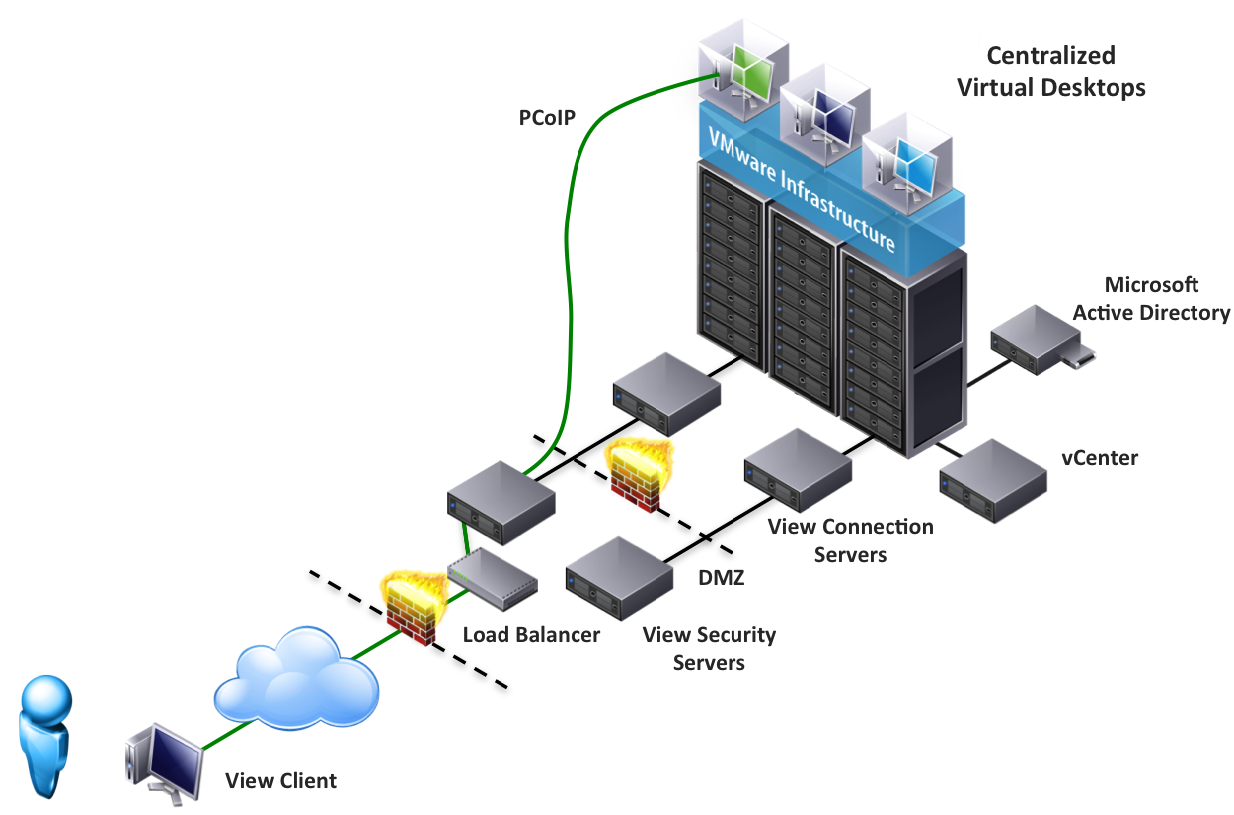
Looking at traditional networks, we notice that often something that may seem simple, such as upgrading software on users' devices, can easily turn into a nightmare and lead to the appearance of vulnerabilities and their exploitation by unauthorized users.
VDI solutions enable administrators to centrally control and configure corporate digital terminals with certain significant advantages:
- Now installing a new terminal can be done in a few minutes instead of a few hours.
- Virtual terminals are more energy efficient and last longer than traditional terminals.
- IT operating costs are reduced, at least theoretically, due to the reduction in support needs.
- The reduction in compatibility issues is also characteristic, especially when it comes to specialized software.
- The security of the information infrastructure is increasing dramatically. Users can log in to their terminal both inside and outside the information infrastructure, always maintaining a high level of security.
- The centralized management provided by VDI technologies reduces the complexity of upgrades, especially security upgrades, as well as any oversight and maintenance process burdened by IT.
- The time for implementing upgrades and general response is significantly reduced and there is now the possibility of instantaneous reaction and immediate implementation with the maximum degree of success.
- A clear improvement in infrastructure performance is observed with better management of the backup policy, effectively eliminating the problems arising from local user backup.
Along with the adoption of VDI solutions, not only is the use and purchase of hardware reduced since we are now moving to the overall more economical solutions of thin clients, but the increasingly greater demand of users to connect to the corporate network through their personal devices is also satisfied, a demand which further reduces costs for the company on the one hand, and on the other hand increases the risks regarding the security of the corporate infrastructure. Nevertheless, VDI services adequately solve the various security problems that arise from the adoption of BYOD solutions, giving the answer to the reasonable question of each administrator, how do I introduce a device into the corporate network that is not corporate and adequately controlled?
Many times, the problems faced by administrators of traditional SBC (Server Based Computing) infrastructures are identical to those of VDI infrastructures, since these too are a manifestation of SBC infrastructures. In any case, effective management should be carried out by the IT side in order to adequately protect the corporate information infrastructure. In this direction, VDI solutions smooth out similar challenges to a fairly satisfactory extent.
