

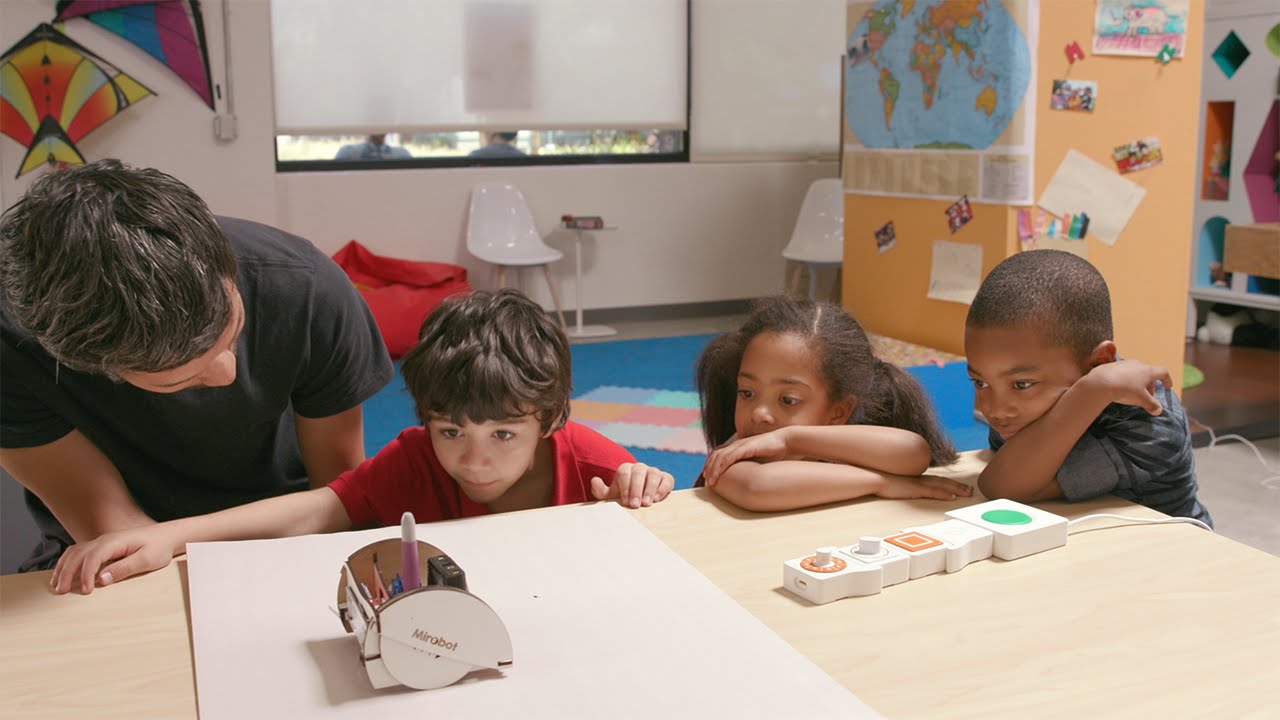
Increasing its dedication to early learning through technology, Google announced Project Bloks, a tool designed to help kids on the path to programming and gadgets.
Project Bloks consists of three components: Base Boards, Pucks, and a Brain Board. The Pucks can be used to prepare various functions (on, off, turn, etc.) and operate by connecting them to the square Base Boards via sensors. These two components receive power and connectivity (Wi-Fi and Bluetooth), connecting to the larger Brain Board.
This approach is an attempt to inspire creativity by using tangible programming on an open hardware platform. Using Project Bloks pieces, children will be able to produce control mechanisms for robots, toys, and even tablets.

“We believe that when kids learn to code, they’re not just learning how to program a computer — they’re learning a whole new language for creative expression and developing computational thinking methods: a set of skills for solving problems of all kinds,” Google Creative Lab members Steve Vranakis and Jayme Goldstein said in a blog post announcing Project Bloks on Monday.
In addition to Google, the project also benefits from collaborative contributions from Stanford University’s Paulo Blikstein and design firm IDEO. Project Bloks is not currently commercially available, but educators can sign up for a chance to participate in the program.
For everyone else, Project Bloks will be available for most of 2016 at the Exploratorium in San Francisco and the Science Museum in London.
