

In a world where more than 1 million people die on the roads every year, when a car manufacturer announces that it aims to have zero fatalities in its cars by 2020, it is reasonable to take this with some caution. Things start to take on a different dimension when it comes to Volvo. As early as 1927, its founders, Asar Gabrielsson and Gustaf Larsson, declared: “Cars are driven by people. Therefore, the basic principle for everything we do at Volvo is and will remain safety.” And it is noteworthy that the risk of being killed or seriously injured in a new Volvo has been reduced by more than 65% compared to cars from the 1970s.
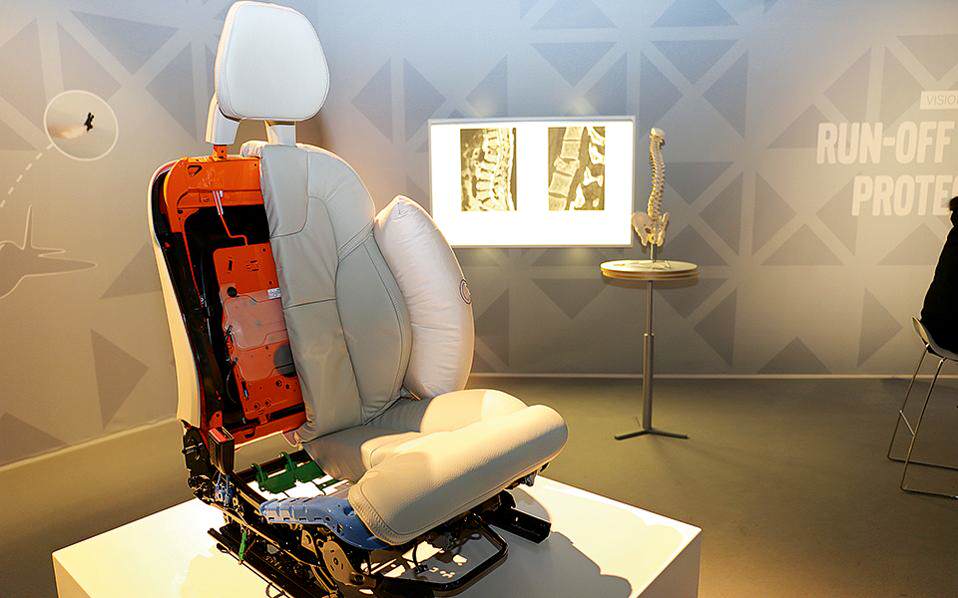
As a result, the Vision 2020 program, to eliminate deaths and serious injuries in accidents by 2020, is perhaps more realistic than it initially seems. One type of injury that still lags behind the overall progress made over the past 40 years is spinal cord injuries from vertical forces in the event of a car swerving, bouncing, and landing on the ground. And this now seems to be finding its solution.
From the amusement park to the automotive industry
In the summer of 2007, Volvo Cars safety expert Anders Axelsson visited Legoland with his daughters and came across the Robocoaster, a ride with a large mechanical arm that makes sudden movements in various directions, entertaining the children on board. “Watching people being thrown in all directions on a Robocoaster ride, I suddenly realized that these extremely sudden, random movements were similar to the violent forces that people are exposed to when a car runs off the road,” says Anders Axelsson.
This experience gave him the idea to create, with the help of industrial robot manufacturer ABB, a seat testing device in the laboratory. This accelerated the study of the forces developed on the body during rollover accidents, and also freed it from the enormous cost of crash tests.
The new test method helped engineers find the right combination of seat shape and seat belt function and the pretensioner that tightens it in the event of an accident, ensuring that the body is held in the correct position in the event of a rollover. Because data collected from the study of real accidents has shown that body posture is an important factor in avoiding spinal injuries.
At the same time, Volvo engineers added to the “skeleton” of the new XC90 seats an energy absorption mechanism produced by the vertical forces developed on the body when the car lands sharply on the ground after an accident.
From the laboratory to the car
The effectiveness of these systems is confirmed in tests with real cars, one of which we had the opportunity to observe up close at Volvo's facilities in Gothenburg.
It is truly shocking to see this whole process of swerving, bouncing, landing hard and, finally, hitting an embankment and to think that it is something that could happen to you or your loved ones. But it is also reassuring to see the progress that has been made in car safety, observing after the test the special dummies (two "adults" and a small "child") protected in their seats with seat belts and airbags, inside a passenger cabin that has been minimally deformed by the violent impact.
Human error will hardly be eliminated, but human ingenuity in protection systems leaves reasonable hope that deaths from road accidents can eventually be reduced to zero.
Source: kathimerini.gr
