

Another serious Tesla accident has brought the safety of its advanced driver assistance systems (Tesla Autopilot) back into the spotlight. The incident occurred in Katy, Texas, when a Tesla veered off the road on a residential street, crashed into a residence at high speed, and fatally injured a 76-year-old woman inside the home.
The crash happened around 8 p.m. Friday in the 21300 block of Rose Hollow Lane, according to local police and the Harris County Sheriff's Office.
How the accident unfolded
Initial information from investigators indicates that the electric vehicle failed to make a right turn at an intersection in the area. Instead of changing direction, it continued at high speed and ended up in front of a residence, literally driving through the room where the elderly woman was.
See also: Tesla to pay $243 million in compensation for Autopilot crash
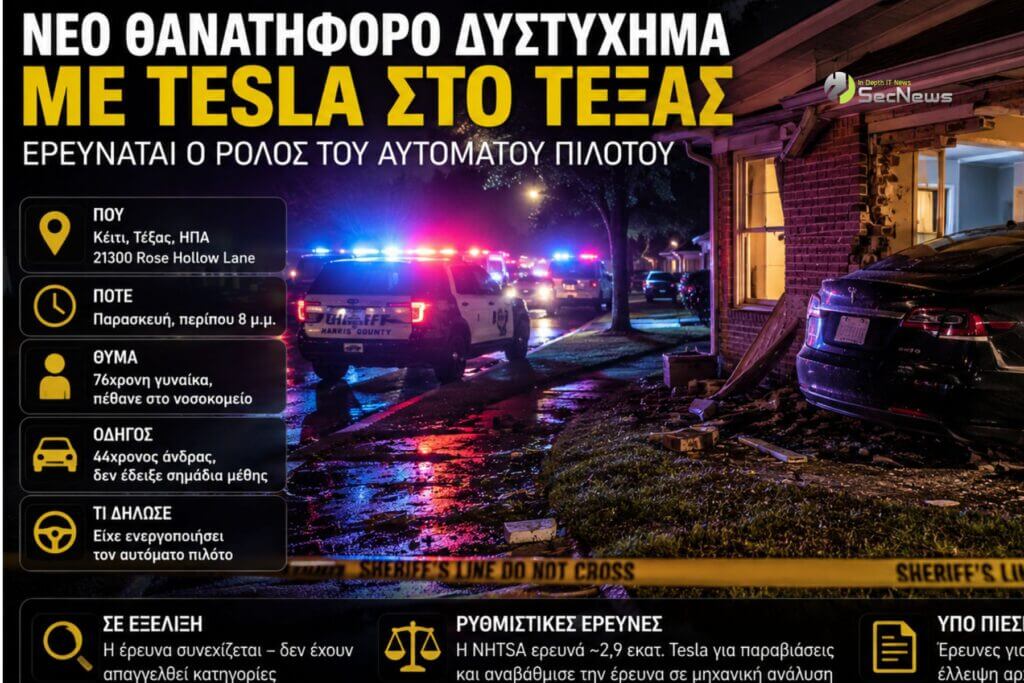
The 76-year-old was airlifted to Memorial Hermann Hospital, where she was pronounced dead a short time later. The driver of the Tesla, a 44-year-old man, was also taken to the hospital with minor injuries. Authorities said he showed no signs of intoxication and was cooperating fully with investigators.
The Tesla Autopilot reference and open questions
Of particular interest is the driver's statement, which told officers that he had activated the Tesla's self-driving system (possibly Autopilot) at the time of the collision. However, investigators emphasize that this claim has not yet been confirmed through technical data from the vehicle.
Authorities have not yet specified which system was being used. Tesla has both Autopilot, which provides assistance in certain driving conditions, and the more advanced Full Self-Driving (Supervised) package. Despite their brand names, neither makes the vehicle fully autonomous.
The company points out that the driver must remain alert at all times, with his hands close to the steering wheel and ready to immediately take control when required.
See also: Tesla removes Basic Autopilot from standard feature
The challenge of human trust in technology
The new accident highlights a broader issue that concerns the smart vehicle industry: the overconfidence that drivers often show in the capabilities of assistance systems.
Several road safety experts have warned that the term "autopilot" can create the false impression that the car can move without human intervention. In practice, these systems function more as advanced driving assistants than as fully autonomous drivers.
The challenge becomes even greater as technology evolves. Drivers tend to quickly become familiar with the capabilities of the software, which can lead to reduced attention and delayed reactions when an unforeseen situation arises.
Growing regulatory pressure on Tesla
The incident comes as Tesla's driver assistance systems are already under scrutiny by US authorities. The National Highway Traffic Safety Administration has launched investigations into millions of the company's vehicles, looking into reports of red light violations, incorrect reactions at intersections and incidents of driving in the wrong direction.
See also: Tesla misled customers about Autopilot capabilities

At the same time, Tesla is facing separate investigations into how it records and reports accidents associated with its Autopilot and Full Self-Driving systems. These developments are intensifying the debate over how semi-autonomous driving technologies should be tested and certified.
The accident in Texas is yet another reminder that the transition to fully autonomous transportation remains a complex process, in which technology, human behavior, and the regulatory framework must work together safely.
