

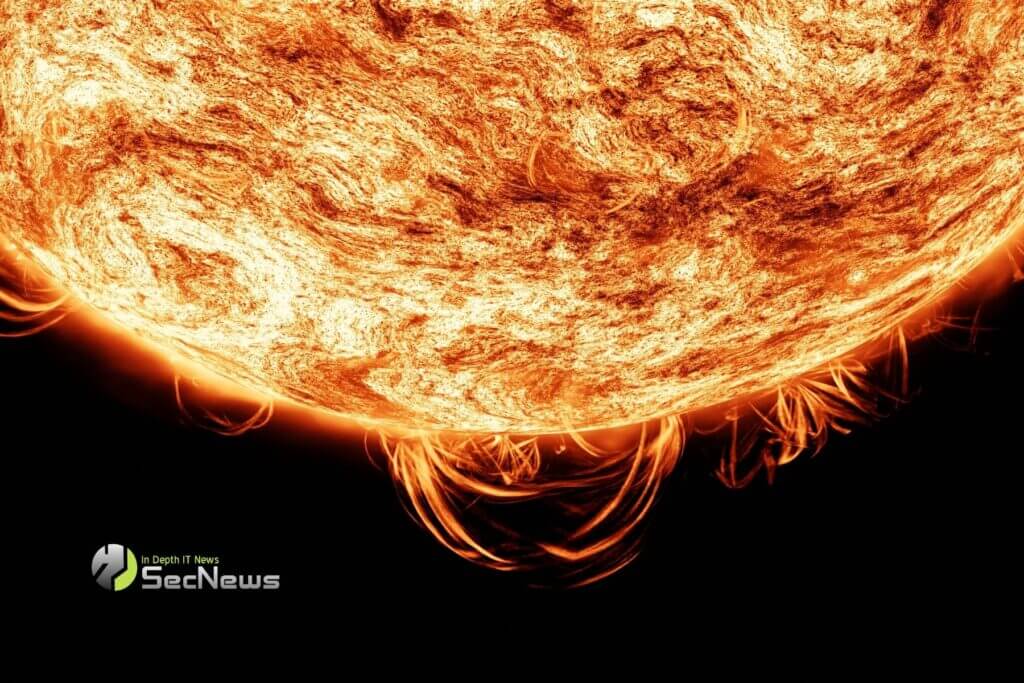
A powerful M5.7 solar flare erupted on the Sun on May 10, triggering a spectacular coronal mass ejection (CME), which may pass close to Earth tonight and possibly create aurora borealis displays in high-latitude regions.
See also: Solar flares may cause earthquakes
The outburst peaked at 9:39 a.m. EDT (1:39 p.m. GMT) and originated from sunspot region AR4436, which is now orbiting Earth's so-called "impact zone" on the sun's northeastern edge. As this active region becomes more visible in the coming days, any new powerful flares or coronal mass ejections will have a greater chance of being directed toward Earth.
See also: Europe: Simulation of a catastrophic solar storm – Dangers
Although most of the recent CME appears to be moving east of Earth, NOAA's Space Weather Prediction Center and the UK Met Office estimate that some of the expanding cloud of solar material may touch Earth around early May 13. If this happens, it could trigger a mild G1 geomagnetic storm, enhancing the appearance of the aurora borealis in the northern states of the US and the UK.

Solar flares are classified on a scale of A, B, C, M and X, with category X corresponding to the most powerful explosions. Each step on the scale represents a tenfold increase in the energy released. The phenomenon on May 10 reached an intensity of M5.7, which makes it a particularly powerful flare, capable of causing disruptions to radio communications on Earth.
See also: The strongest solar flare of 2025 affects Europe and Asia

For the next few days, both NOAA's Space Weather Prediction Center and the UK's Met Office are warning of increased solar activity. Both agencies estimate that there is a possibility of new M-class flares, but even X-class explosions, as sunspot regions AR4436 and AR4432 continue to evolve.
