

Astronomers may have found evidence that some of the mysterious "little red dots" spotted by the James Webb Space Telescope (JWST) are not black holes, as initially suggested, but giant stars from the early stages of the universe.
See also: New findings from James Webb in the "Eye of God"
The research team reached this conclusion by developing a simplified model of supermassive protostars — possible "ancestors" of the universe's first supermassive black holes.
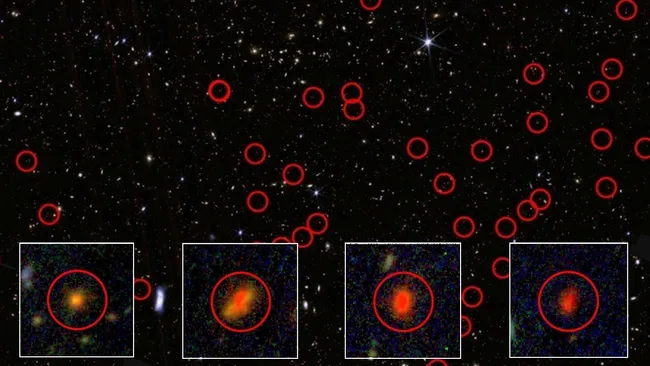
The “little red dots,” which existed within the first 2 billion years after the Big Bang, are one of JWST’s most unexpected discoveries. Initially, astronomers hypothesized that these compact red objects could be active galactic nuclei (AGN), large galaxies powered by black holes that are rapidly accreting matter. However, the data was not clear.
See also: "Enigmatic" object discovered by the James Webb telescope
The objects are extremely small — smaller than would be expected for typical galaxies. In addition, they have so far failed to show clear X-ray emission, the hallmark of an actively feeding black hole. Their spectra also lack strong emission lines from metals beyond hydrogen and helium, suggesting that the surrounding gas may be chemically primitive — unlike the metal-rich regions that typically surround active black holes.
This led Devesh Nandal and Avi Loeb from the Harvard & Smithsonian Center for Astrophysics (CfA) to consider an alternative scenario: could these compact objects actually be supermassive stars, observed just before they collapse into black holes?
Detailed spectroscopic measurements that reveal the chemical composition around the "little red dots" could strengthen or reject the interpretation that these are supermassive stars.
See also: James Webb: Galaxies in the early universe were chaotic

The team's study was published February 5 in The Astrophysical Journal.
