

NASA recently presented the first images from the newly built Nancy Grace Roman, which is expected to make a decisive contribution to the search for exoplanets, mapping the Milky Way, and investigating fundamental cosmic mysteries, such as the true nature of dark matter.
See also: Photobombing: Satellites are making it difficult for Hubble and other telescopes
Roman is NASA's next flagship space telescope, following Hubble, which launched in 1990, and James Webb, which is scheduled to launch in 2021. The orbiting observatory is named after pioneering scientist Nancy Grace Roman, NASA's first chief astronomer (1960–1962), and will operate in addition to Hubble and JWST, without replacing existing telescopes.

The telescope is approximately 12.7 meters tall and weighs more than 4,100 tons . Its construction began in February 2016 and, according to scientists, the project remains within the original budget of 4.3 billion dollars.
After launch, Roman will be positioned about 1.6 million kilometers from Earth, at a Lagrange point — a fixed location relative to our planet where the gravitational forces of two bodies balance. Specifically, it will be located at the Sun–Earth L2, which is already home to the James Webb Space Telescope, as well as the European Space Agency's Gaia and Euclid spacecraft.
See also: "Enigmatic" object discovered by the James Webb telescope
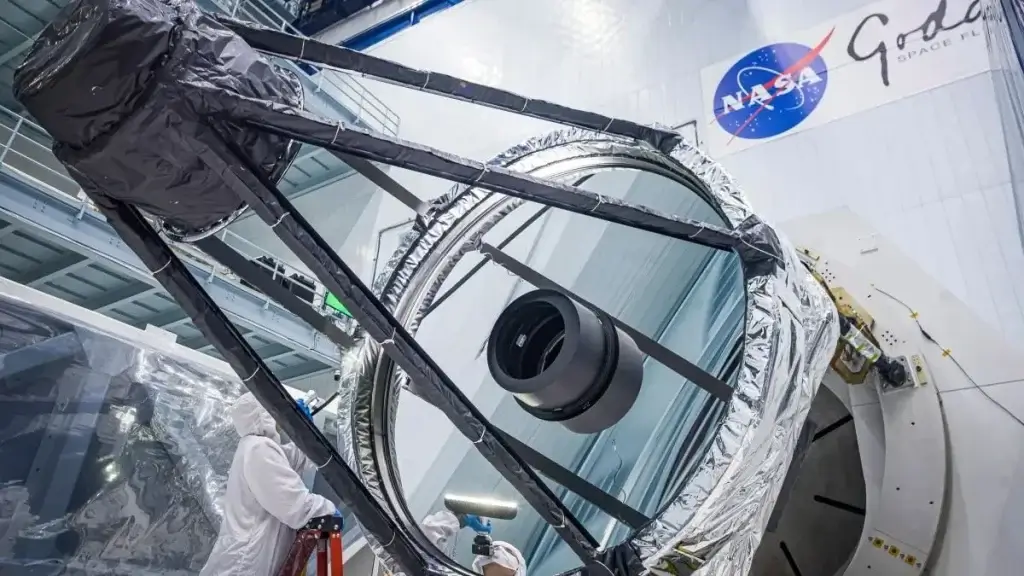
Roman has two key scientific instruments that will define the goals of its initial five-year mission. The first is the Wide Field Instrument (WFI), a 288-megapixel camera attached to a 2.4-meter-diameter mirror capable of capturing high-resolution images of the outer solar system, the limits of the visible universe, and everything in between, in infrared light that the human eye cannot detect.
One of Roman's main goals is to create the most detailed map of the center of the Milky Way to date, as part of the Galactic Plane Survey, which will cover at least 25% of its total observing time. At the same time, the telescope will explore the wider universe, searching for distant galaxy clusters and vast "cosmic voids", elements that, according to a recent NASA announcement, may shed light on the nature of dark matter and dark energy.
However, the telescope's "secret weapon" is considered to be the Coronagraph Instrument, which will isolate the bright light of distant stars, allowing WFI to capture images of exoplanets, which under normal conditions would be lost in the blinding glow of their stars. In total, Roman is estimated to collect more than 20,000 terabytes of data during its initial five-year mission.
See also: The James Webb Telescope may have spotted "dark stars" in the distant universe
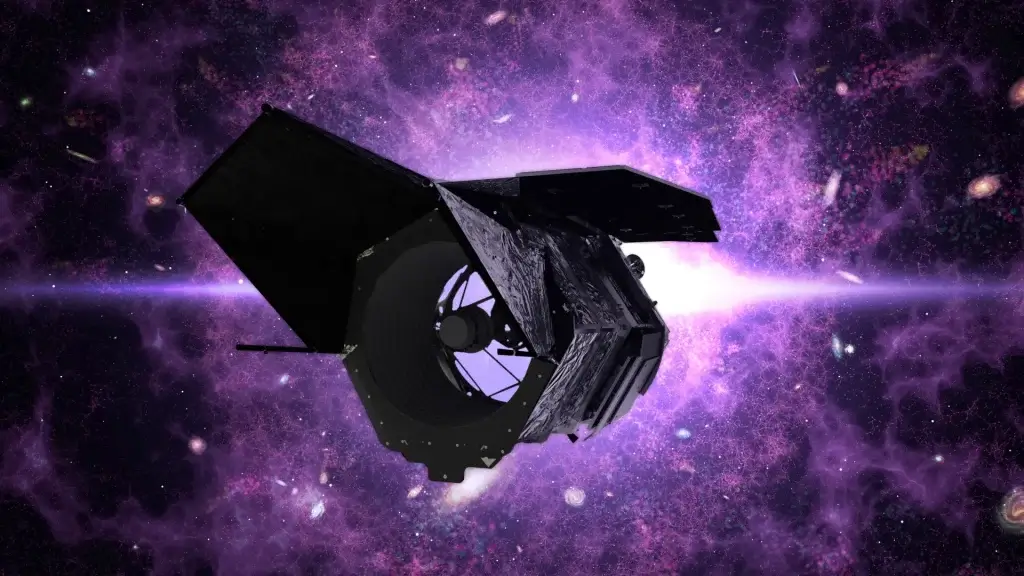
On January 5, at the 247th Meeting of the American Astronomical Society in Phoenix, Arizona, program scientists announced that, based on current data, the earliest possible launch date for Roman is September 28.
