

It's been a while since Macs stopped relying on Intel processors. There's new evidence that they've outlived their usefulness. The move to Apple-designed chips will improve macOS devices for a number of reasons, including increased speed and battery life.

The iPad and iPhone already use Apple-designed processors. Unconfirmed reports suggest the company is moving forward with plans to remove Intel processors from Macs. The first MacBook or iMac with an Apple processor could be released in 2020.
Apple's A-series processors will soon be faster than Intel Core processors
We compared Geekbench 4 scores of the top-of-the-line MacBook Pro and iPad Pro over four years. Then we made assumptions about the next two years.
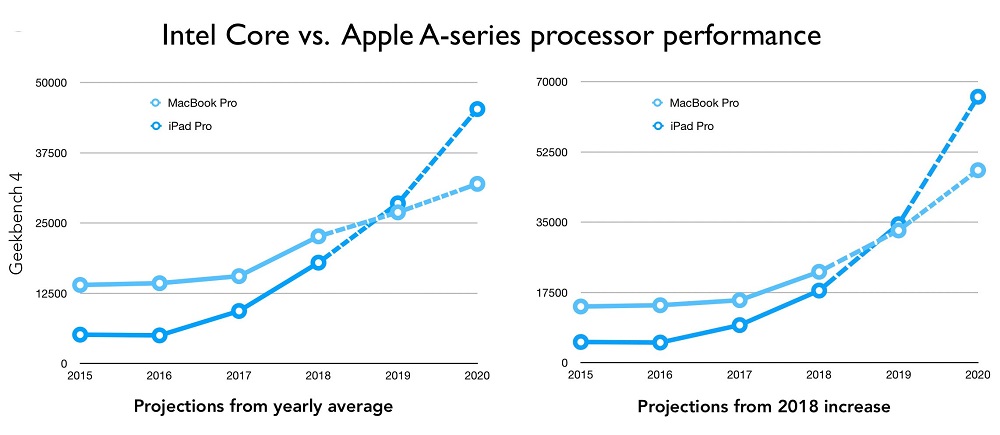
The chart on the left uses the four-year average annual percentage increase in performance to predict the future. For the MacBook Pro, the average annual improvement is 18.9%. For the iPad Pro, it's 58.9%.
Because there was a big jump in MacBook Pro performance between 2017 and 2018, the chart on the right simply uses that performance improvement to make two-year estimates.
Regardless of the method used, our projections show that the iP19 Pro will be faster than the best MacBook Pro, and the 2020 tablet will be much faster than Apple's top laptop.
This assumes the 2020 MacBook Pro will use an Intel processor, of course. Moving to an Apple chip, as rumored, seems to offer much better performance.
How this will affect pro users who need extreme performance is not yet clear. It's possible that Apple will make the transition from Intel's A-series chips in phases, leaving nothing to change for graphics users until Apple has a chip with the performance they need.
There are no Intel processor shortages
It doesn't matter how fast a processor is if it's not available. And that's been a problem for Mac manufacturers recently.
Apple isn't Intel's biggest customer by a long shot. The Mac captured just 6.8% of the global PC market in the first quarter of this year, and there are three companies with much higher shares. That's important because Intel is struggling to produce enough processors to meet demand, and of course, the biggest customers almost always get priority.
The result is that Apple isn’t getting all the chips it needs. CEO Tim Cook said this week: “For our Mac business overall, we experienced some processor constraints in the March quarter, leading to a 5% year-over-year decline in revenue. However, we believe Mac revenue would have been up year-over-year without these constraints.”
This means that Apple missed out on at least $263 million in Mac sales because Intel couldn't match it.
What's even more important are the customers who didn't get a Mac because Apple didn't have the chip to equip them with. According to Gartner, Apple sold about 100,000 fewer desktops and laptops in the first quarter than it did in the same period in 2018. Again, Cook believes his company probably would have sold more Macs in the first quarter than it did last year, had many people been left out because of Intel.
This situation would change significantly if macOS computers used Apple processors. Apple designs its own A-series chips, but outsources production to Taiwan's TSMC. And because there were over 200 million iPhones shipped last quarter, Apple is believed to be TSMC's largest customer and therefore less likely to be affected by any production issues.
Not that TSMC is known for its problems. Instead, in partnership with Apple, this company has been producing improved versions of the A-series every year since the release of the original iPhone.
Apple processors may be cheaper
We speculate that TSMC, since Apple is its largest customer, will be able to get better prices on the chips. On the other hand, because it buys fewer processors from Intel than other computer manufacturers, Apple probably can't negotiate to get better prices.
Better battery life for MacBooks with Apple chips
The latest 12.9-inch iPad Pro already boasts faster performance than the 13-inch MacBook Pro that also came out last year. Their screens are nearly the same size, but the rest of the tablet is much smaller. Still, the tablet has a much longer battery life: about 13 hours compared to about 9 hours.
The main difference is the processors. Apple's 7nm A-series is much more energy efficient than the 14nm Intel Core chip in the notebook.
As a result, the iPad produces much less heat – we could call it heat and wasted power. The tablet doesn't even have a fan, because it really never needs one. The MacBook Pro definitely has a fan, and it definitely needs one.
A MacBook Pro running an Apple-designed processor could also do without a fan. Or at least use it much less.
Mac, iPhone, and iPad will be more compatible with each other
This hardware change will also bring significant changes to the software, bringing Mac and iPhone/iPad apps closer together.
Let's be clear: Apple isn't merging macOS and iOS. However, the company is making it easier for developers to create apps that can run on iPhone, iPad, and Mac. This task would be easier if all three types of computers ran on the same processor.
Those who will benefit the most from this move are Mac users.
Still, switching from Intel processors to Apple processors will be a pain. But there are two things to remember. One is that Apple has done this many times before. In 2005, the company moved Macs from PowerPC to Intel.
The other thought is that switching to Apple processors is going to bring loads of improvements. Faster performance, better battery life, maybe even lower cost. All of that is of course worth some hassle.
