

From time to time we hear or read endless discussions about freedom on the internet, the protection of our privacy and data, about hackers who threaten the universe, about demonic police officers (we do not say or show names  ) who protect us, about bad wolves and unprotected Little Red Riding Hoods.
The idea for the article came after news broke of the arrest of a top Kaspersky security researcher.Russian authorities have arrested Ruslan Stoyanov, one of Kaspersky Lab's top security researchers, on charges of treason.
According to a report by the Russian newspaper Kommersant, Stoyanov was arrested in December, along with the head of the Russian secret service's (FSB) information security department, Sergei Mikhailov.
Of course, the company states that Stoyanov was arrested for activities he had before joining the company and therefore the charges against the employee in question do not involve Kaspersky Lab.
In this particular case, we observe cooperation between Russian intelligence services and a leading security researcher. The subject of the cooperation is and will remain unknown.
What are the boundaries on the Internet and who defines them? What is a safe internet and by what criteria do we define it? Who is a protector and who is the offender? Are there visible, distinct signs that make the roles distinguishable? Is there freedom? Is there absolute privacy? In the above philosophical questions, there are various opinions translated in a way that suits the person expressing them.
An example of convenient answers to what freedom and a safe Internet are, is the case of “Elder Pastitsios.”
The Three-Member Court of First Instance of Athens sentenced the “Elder” or in the world Philippos Loizos to ten months of suspended imprisonment, for insulting religion repeatedly. Let us recall that the prosecution for insulting the gods (by the then commander of the National Public Service Authority Manolis Sfakianakis) had been brought against him following a question in Parliament by the former Golden Dawn MP, Christos Pappas, who was previously detained for forming a criminal organization.
The case actually began in September 2012 when Pappas filed a question about the satirical page Elder Pastitsios. In his question, he stated that: “the user insults, mocks and tries to humiliate the holy figure of Greek Orthodoxy, Elder Paisios.”
His arrest had caused and continues to cause very strong reactions on the Internet.
The announcement by the human rights organization in Greece emphasizes that:
“The decision shows that freedom of speech, a fundamental pillar of social coexistence in a democratic state governed by the rule of law, is under question not only by the constitutional enemies of democracy but also by its state-appointed protectors.”
(The Hellenic Union for Human and Citizen Rights (EEDAP) is the oldest Non-Governmental Organization for the protection of human rights in Greece. The Union was originally founded in 1936, with Alexandros Svolos as president, and was dissolved by the dictatorship of August 4. It was re-established in 1953.)
But there are worse ones:
Recall the case where the FBI seized the world’s largest child pornography website, Playpen, and ran it on government servers for 13 days in an attempt to trap pedophiles with malware. With the malware, known to law enforcement as a “network investigative technique” (NIT), they attempted to infiltrate the TOR of users who accessed the site via the Dark Web.
There's no doubt that any kind of child abuse (let alone sexual abuse) is one of the worst crimes, but the way the FBI handled the case is equally disturbing. Imagine if the Feds allowed these sites to operate with child victims, citing the pretext of an investigation.
In an internet that we want to be bound by law, and safe, the FBI itself is committing the same crime as the criminals it puts behind bars.
In this specific case, we should ask ourselves whether facilitating the sexual abuse of children is worth the arrest of approximately 100 alleged pedophiles and, of course, the glory for the "defenders" of justice.
When Peter Steiner's now-famous cartoon with the caption "On the Internet, no one knows if you're a dog" was published in the New Yorker in 1993, it didn't make much of an impression. It was still the beginning of the Internet and many people didn't know what it was referring to.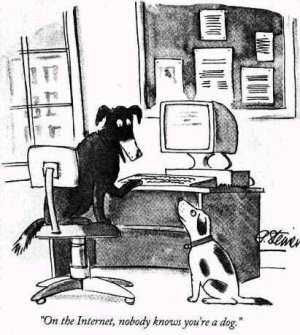
Over time, it became a slogan, a play (Nobody Knows I'ma Dog by Alan David Perkins), the subject of sociological research (Morahan-Martin and Schumacher, 2000) on the anonymous online presence of timid, shy, phobic or even abnormal people, as well as on the phenomenon of "online impersonation" (presenting oneself as a person of another gender, age or status) by David Trend.
It was also mentioned and featured in Bill Gates' book "The Road Ahead.".
Internet (usenet) pioneer John Gilmore described the symbolism of this cartoon in one sentence: "it means that Cyberspace will be liberating, because gender, race, age, appearance, even 'dogness', are absent there.".
This is of course one side of anonymity on the Internet that acts liberatingly, protects privacy, makes possible personal confession or the channeling of valuable information, which the media does not dare to publish. They are often the only source of news from countries with totalitarian and illiberal regimes. It is a democratic revolution.
Anonymity, along with the ease of publishing (even a dog can set up a blog), has brought about the greatest change in the field of publicity since the invention of printing. Every citizen, for an expense of a few euros per month, can become “his own publisher” and have access to thousands or even millions of readers. He can also participate in discussion groups (fora and chat), in meeting places or in parallel life spaces (such as Second Life) without revealing his identity.
The other side of the same coin is the negative:
Anonymity facilitates irresponsible rumor-mongering, slander, online gossip, threats, and insults. Not to mention cybercrime – which is also usually based on anonymity.
Although it is often exaggerated by the media (like everything new), it is today a reality:
From the hacker who breaks the Pentagon's secret codes to the robber who opens bank accounts or steals credit cards. Not to mention other criminal behaviors that are reinforced by anonymity, such as that of the pedophile, the neo-Nazi, the terrorist, but also, as we saw above, by the Authorities themselves.
Because on the Internet, no one knows if you're a dog.
________________
Sources
https://www.ndimou.gr/
https://www.tovima.gr/society/article/?aid=557665
