

An urgent call for the rapid organization and mass participation of American Internet users in protest rallies on Thursday, November 6, 2014, outside the offices of the three largest Internet access companies is being called by a multitude of organizations, providers of popular Internet services, and prominent Internet residents from the United States.
“Team Internet” must convince “Team Cable,” they say, that the Internet should not have toll booths, from battleforthenet.com, in the second appeal of the year for the same cause, “Net Neutrality.”.
The appeal is made by, among others, the popular video streaming services Netflix and Vimeo, Foursquare, the crowdfunding platform Kickstarter, the popular news site Reddit and the company behind the blogging tool, Tublr, a number of organizations for the protection of digital rights such as the powerful ACLU in the US and the particularly active Electronic Frontier Foundation (EFF) in Europe, and a number of online personalities.
The reason for this urgent call was the leak of proposals from the Federal Communications Commission (FCC), the Internet regulator. The Commission is reported to be proposing a regulation that would allow companies that provide broadband Internet through their networks to prioritize the data packages of services that pay them for it. They argue that this way, for example, a newly created streaming service would not be able to offer the same quality of moving image transmission over the Internet as that of a major market player that would be able to pay to ensure the quality of its own service, thus condemning the newly created and potentially innovative service, which has not yet secured its revenues, to "death".
No one could have said it better than a comedian, say the organizers of the protests and refer to John Oliver:
The organizers' main argument is that ISPs shouldn't be allowed to offer two-lane Internet, fast and slow, depending on who pays for the infrastructure. Just as phone companies can't decide who you call or what you say on the phone, ISPs, they say, shouldn't be able to essentially shut down services that don't have to pay the toll to get into the left lane of fast Internet.
The FCC proposal brings back to the forefront the issue of Net Neutrality or Open Internet, in which the protagonists are communications companies that do not tolerate services like Google or Netflix to get the most out of their expensive infrastructure without collecting any fees from it, while they either acquire paying subscribers or advertising revenue. On the other hand, ISPs are called on to invest in the adequacy of their networks to meet the demand for YouTube videos or movies with streaming technology from Netflix.
Major content providers have already reacted in various ways. Notably, Google - which is absent from the current list of supporters of the November 6 protests - and Netflix - responded to the telecom companies in the first such protest on "Internet Slowdown Day" on September 10, 2014.
Netflix responded to the American networks with a graphic representation of the historical average performance of its service among ISPs (best prime time Netflix streaming experience). Google also invited ISPs to a similar showdown on YouTube. It seems like they are telling the networks that, “you owe us your growth and our service has the power to convince your subscribers to move from your network to another, which will provide our service better.”.
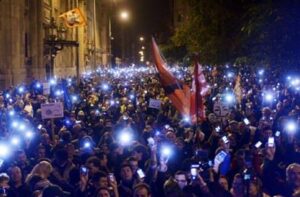
Organizers of the Net Neutrality and Open Internet protests are calling on protesters to follow the example of the Hungarians, who earlier succeeded in withdrawing a proposal to impose a tax on Internet data traffic through ISPs of 0.50 euros per gigabyte. In Budapest, thousands of people held up their illuminated mobile phones on October 26 and 28, 2014, to send their message to the Orbán government, and American Internet users are being urged to do the same in their message in all directions on November 6.
Source: tech.in.gr
