

A host of scientific discoveries accompany the adventurous mission of the European Space Agency's (ESA) Rosetta spacecraft to comet 67P/Churyumov-Gerasimenko
Scientists have released the first batch of their findings, after analyzing the scientific data they have collected so far. The main conclusion: either this comet in particular is very strange, or more generally, many of the theories about comets that have been held up to now need to be revised.
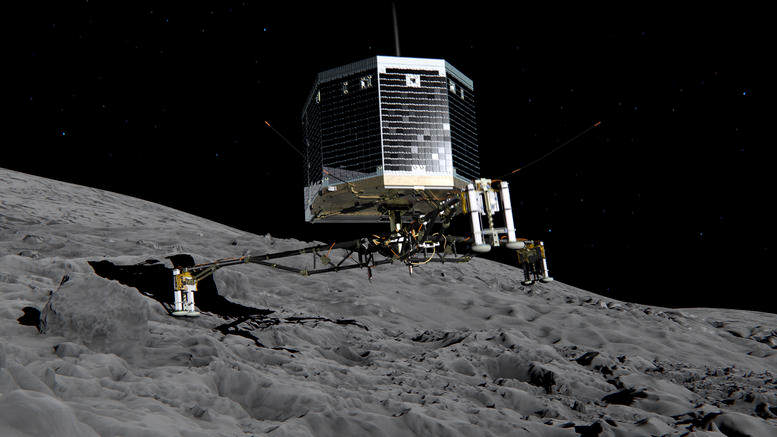
" Rosetta", after its ten-year journey to reach it, continues to closely follow the four-kilometer diameter comet, on which the "Philae" in a dormant state.
Comets are believed to be icy remnants from the birth of our solar system about 4.6 billion years ago. Rosettaisexpected to shed more light on this early phase of our solar system.
The discoveries of "Rosetta" so far (the analyses of the data that " Philae " managed to send will be made public later) were published in seven separate studies, in a special issue of the magazine "Science", according to the BBC, the Reuters agency, "New Scientist" and Space.com. The most characteristic are summarized as follows:
The rugged, duck-shaped comet is covered in surprisingly simple organic molecules, while scientists expected to find more complex ones. It has detected little water ice on its surface, but large amounts of hydrocarbons (the first time such a discovery has been made on a comet). This overturns the prevailing theory that comets are mostly water ice, as in this case much more carbon dioxide was detected than water vapor.
The comet appears to be made up of roughly equal-sized "lumps," which are likely the original building blocks of our solar system. If confirmed, this would be a major discovery, according to scientists. The initial dust and gases likely formed the first "pebbles," and these, in turn, formed the larger "lumps," each about three meters in diameter. From their fusion, the comet's nucleus was eventually formed.
This nucleus is much fluffier and more porous than previously thought (70% to 80% of its interior is believed to be empty space). There is a possibility that it is two smaller comets that at some point merged.
The strong gusts of wind, blowing at a speed of 300 meters per second, seem to create dunes of dust particles on the comet, which has left scientists speechless.
The comet's northern hemisphere is warmer than the southern, an indication of seasonal changes.
The comet's surface reflects only 6% of the solar radiation it receives, making it one of the darkest objects in our solar system.
The comet makes a complete rotation every 12.4 hours, its mass reaches 10 billion tons, its volume is 21.4 cubic kilometers and its density is 470 kilograms per cubic meter (as much as cotton). Its gravity is so low that if a person were to stand on the comet, they would bounce high into space (as unfortunately "Philae" did).
Many of the theoretical ideas scientists have about comets will have to change now that they have first-hand evidence of one. “We used to think of comets as ‘dirty snowballs,’ but they would be better described as ‘frozen dustballs,’” said Simon Green of the Open University in Britain. But that doesn’t rule out the possibility that other comets are indeed ‘dirty snowballs.’
Rosetta's closest approach to the comet will be on August 13, at a distance of about 186 million kilometers from the Sun. By then, Philae may have "awakened" if its collectors receive more solar energy for its depleted batteries.
Source: APE/MPA
