

LinkedIn has ended up being the exact opposite of what it set out to be. Instead of a professional knowledge-sharing network, it has become a reality TV show where every registered professional pretends to be someone they’re not — the LinkedIn cringe phenomenon has now become a well-established term. Elon Musk called it “ cringe ,” and he’s absolutely right. On June 24, 2026, in response to a post by Craig Weiss on X that said LinkedIn was “making him lose faith in humanity,” Musk wrote four words that went viral: “Posting on LinkedIn is cringe.” The platform’s response was revealing. Thousands of users of the very platform he was criticizing immediately took sides, highlighting exactly the problem.
Read more: Meta Muse Spark: The new generation of social AI

LinkedIn cringe is not an exaggeration, it's a diagnosis
Musk’s criticism comes from a source with obvious vested interests, as he promotes X as a competitive recruiting platform. That doesn’t negate the point of his observation, though. It’s not just a sudden outburst. Musk has been repeating the same criticism for three years. In 2024, he said he “automatically loses respect for anyone who posts on LinkedIn, it’s unbearably cringeworthy,” according to the Indian Express. He then called the platform “so cringeworthy it’ll make your nails turn.” In 2025, he spoke of “lethal levels of cringe.” It’s an obsession, yes, but it’s an obsession with a basis.
The question isn’t whether LinkedIn has any use. It does, as a job search tool. The question is what content it has come to produce every day. Open your feed at any time of day. You’ll see the same formula in countless variations: someone announces their promotion as if they’re receiving a Nobel Prize. Someone else breaks down in ten bullet points how getting fired “was the greatest blessing.” A third shares “three lessons” from a coffee meeting. A fourth writes a lengthy manifesto on leadership with a thousand star emojis. It’s not professional content. It’s theatrical.
LinkedIn has become the new Instagram, only worse
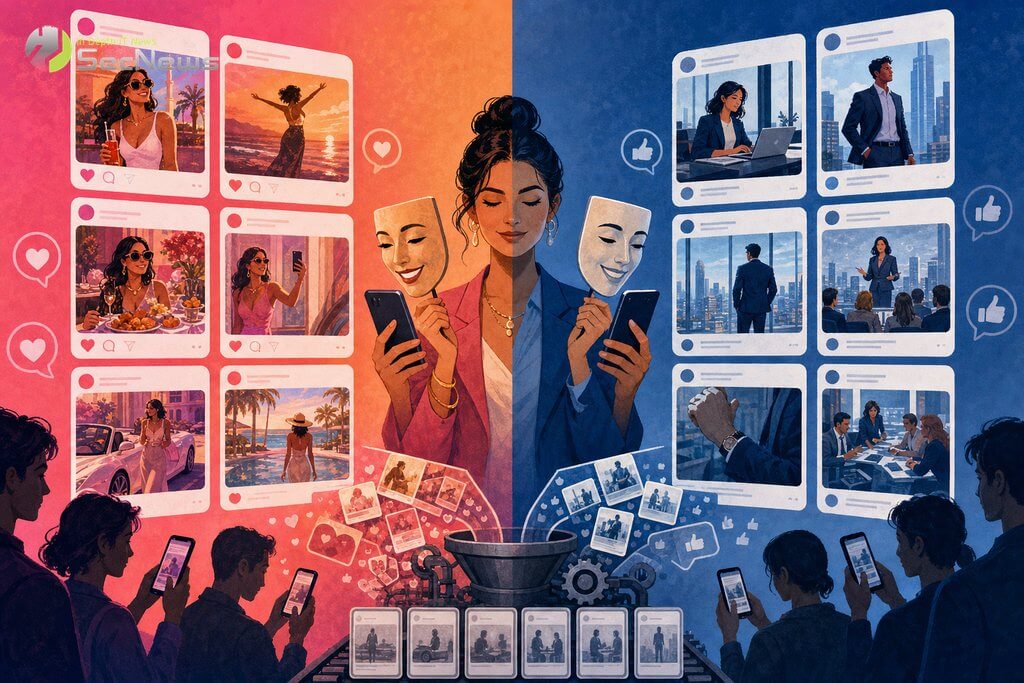
If there's anything more tiring than Instagram, it's LinkedIn trying to become Instagram. Users have transferred to the professional network exactly the habits that made Instagram inhospitable and untrue. Posing, exaggerated success stories, humblebrags that start with "I can't believe it yet, but...", entire narrative structures translated into professional code. The platform's top "influencers" divide their publications into three categories: 50% marketing content, 30% personal narratives like "how I got a job," and 20% hidden advertising, according to an analysis by Rocksalt.
The worst part is that on Instagram, at least you know it. The level of fakery is well-known and the public treats it with a corresponding degree of caution. But LinkedIn still sells you the idea that it is a serious, professional platform, while simultaneously bombarding you with content that would make even the “Follow me for more” TikTok user jealous. The fake promotion announcements, the fake “I’m dying to announce” posts, the metaphysical leadership observations written by ChatGPT, all served up with the seriousness of a supposedly professional context. It’s more hypocritical than Instagram, because it pretends not to be.
The LinkedIn coaching industry has even standardized the language. You know the hooks: “I got laid off at 32 and within 6 months…”. “Nobody tells you this about networking, but…”. “I’ve seen 500 CVs in the last month and they all make the same mistake…”. Entire courses teach copy-paste formulas, with hooks, blank lines between each bullet and a final “what role are you in?” question for engagement bait. LinkedIn is filled with 100 posts a day that start with identical opening sentences, written by people who seriously think they’re building a personal brand.
Why LinkedIn Promotion Is Hurting You Professionally
It’s not just a cosmetic issue. Over-promoting yourself on LinkedIn has real professional consequences that many users ignore. The first and most immediate risk is that you show potential employers or clients that you invest more time in writing triumphant posts than in the work you’re asking them to pay for. A candidate who posts three times a week about how great a professional they are is sending the exact opposite signal to what they think they are.
Second, and more damaging, is the risk of credibility. When you turn your professional profile into a constant narrative of personal success, serious professionals who follow you are not impressed. Quite the opposite. Serious professionals work. They don’t have time for daily performative content. When someone floods their feed with 200 posts a year about how special they are, the signal they get is that they either don’t have a real job or are an unreliable megalomaniac. Neither assessment is helpful for a career.
Third, the algorithmic risk. LinkedIn itself has understood the problem and is actively punishing it. According to Forbes, the new 360Brew ranking system of 2026 “punishes” five specific behaviors: external links, generic AI content, engagement pods, comment baiting, and likes without real interaction. The average reach of posts has collapsed by 50-60% since 2023, with users with 10,000 followers getting just 734 impressions per post. The harder you try to play the old game, the fewer people you will reach.
Fourth, and perhaps most serious, is the security risk. Every detail you post on LinkedIn becomes raw material for social engineering attacks. The technologies your company uses, the names of colleagues, internal projects, tools, everything is exposed. The Lazarus Group’s fake job posting attacks on LinkedIn, recently documented by Check Point Research, exploit precisely the self-promotional nature of targeted professionals. The more you say, the more tools you give attackers.
Related: Manus AI: The War of AI Services
The influencer industry is a commercial scam
Behind the wave of performative posts lies a fully commercialized market that exploits everyone. The average LinkedIn influencer currently charges $15,000 for a sponsored post for an audience of 400,000 followers. Stripping out bots and inactive accounts (typically 45%), the true cost per thousand views rises to $375. It is 10-35 times more expensive than programmatic advertising, with worse targeting, zero attribution, and no optimization capabilities. Businesses that pay such fees are buying air with image.
Even more revealing, 71.36% of LinkedIn influencer profiles have an engagement rate between 0-1%. Only 2.05% reach 5% or more. In practice, most “influencers” don’t influence anyone. They just have larger follower counts than you. Nevertheless, thousands of aspiring professionals see these numbers and rush to imitate them, buying “LinkedIn growth” courses, following templates and pouring hours into content that no one reads seriously.
🔒 Protect your privacy with Proton VPN
Swiss VPN from the creators of Proton Mail — strict no-logs policy, strong encryption, and built-in NetShield that blocks ads, trackers, & malware.
- ✔ No-logs, based in Switzerland (except 14-Eyes)
- ✔ NetShield: blocks ads, trackers & malicious domains
- ✔ Covers all devices — free version available
The link is an affiliate link — SecNews may receive a commission at no additional cost to you. It does not affect the independence of our article writing.
How to use LinkedIn without cringe
The solution isn’t to leave the platform. It’s to use it as a professional, not as a budding influencer. Start by recognizing that LinkedIn is not a publishing platform. It is, as consultant Tom Martin calls it on LinkedIn Pulse, a “24-hour networking event that never stops.” At networking events, you don’t stand at a podium and monologue. You go to people, you ask questions, you listen more than you talk. LinkedIn works the same way.
In practice, this means fewer posts and more substantive comments on other people’s posts. One good comment under a post by a serious professional in your field will give you more credibility than ten performative posts of your own. Forget the hooks, the emoji stars, the “Thoughts?” at the end. Write only when you really have something to say. One substantive post a month is better than three word soup posts a week. And start treating your profile as a resume, not a content creator’s feed.
The truth that no LinkedIn coach will tell you is simple. Truly successful professionals, the ones who will hire you or open doors for you, rarely write on LinkedIn. And when they do, they don’t look like the would-be influencers who flood your feed. Musk has his reasons for attacking LinkedIn, but that doesn’t mean he should be ignored. You know he’s right. It just happens to be someone with a vested interest in saying it.

Useful: Lazarus: Fake job offers become zero-day attacks
