

Scientists believe that the liquid water ocean at Pluto's heart is more salt-dense than Earth's oceans.
A new mathematical model provides insight into what might lie beneath Pluto's icy surface. Sputnik Planitia, as the dwarf planet's heart is called, looks remarkably different from other similar celestial bodies. The new model suggests what might be lurking beneath this peculiar spot.
When New Horizons flew by Pluto in July 2015, it snapped a series of images of the planet . Analyzing the data, scientists had concluded that there is a subsurface ocean of water, possibly preserved to this day, deep beneath the surface ice. By examining the cracks and various features of the Sputnik Planitia region, researchers have now created a model of the ocean hiding beneath and what it might look like.
See also: JWST reveals exoplanet with a “fluffy” atmosphere

They believe that beneath the nitrogen ice surface, there is a shell of water ice 40 to 80 kilometers thick. The team also estimates that the ocean's salt density is at most 8% higher than that of ocean seawater on Earth. This is similar to the density of the Great Salt Flats of Utah.
Of course, we don't know much about Pluto to be sure. But scientists believe that if the ocean were less dense, the ice would collapse, so there would be many more cracks visible in the ice. Similarly, if the ocean were denser, the ice would have fewer cracks.
"We calculated a kind of Goldilocks zone where the density and thickness of the shell are just right," said author Alex Nguyen, of Washington University in St. Louis.
See also: Amateur astronomer discovers five new dwarf galaxies – They are named after him
Before New Horizons arrived at Pluto, the idea of an ocean buried beneath the planet seemed impossible. The planet isn't big enough to have retained much heat since its formation. It's too far from the Sun.
"Pluto is a small body," Nguyen added. "It should have lost almost all of its heat shortly after its formation, so basic calculations would show it is frozen to its core."
However, it appears that a major collision billions of years ago created the ocean, and the gravitational dance between Pluto and its moon Charon may help it stay that way – but not alone. The chemical compositions, as well as the geological suggestions presented in this work, come into play to explain how such an ocean could survive for so long on such a frigid world.
See also: Something strange is happening with Earth's magnetotail
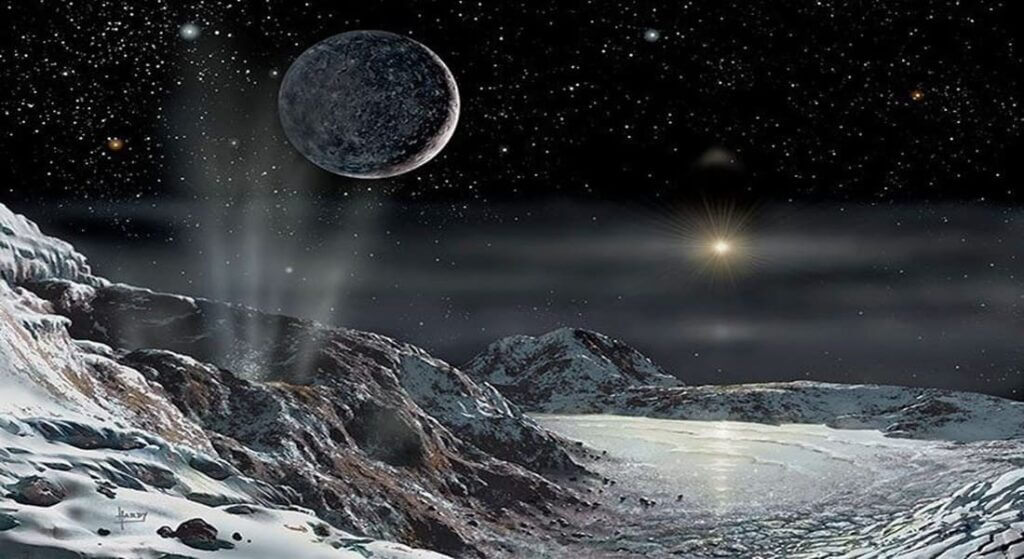
The study is published in the journal Icarus.
The discovery of evidence of an ocean beneath Pluto's surface has important implications for our understanding of planetary systems. First, it shows that even remote and cold worlds can harbor water, expanding the possibility of oceans on other icy moons and dwarf planets in solar system and beyond.
The existence of a subsurface ocean on Pluto suggests that the dwarf planet has internal heat. This changes our understanding of the geological and thermal evolution of small planetary bodies and may lead to new theories about the formation and evolution of planetary systems.
The discovery of new evidence reinforces the need for further exploration of the outer regions of our solar system. The study of Pluto and other icy bodies can reveal important information about the history and evolution of our solar system, as well as the possibility of life on other worlds.
Source: www.iflscience.com
