

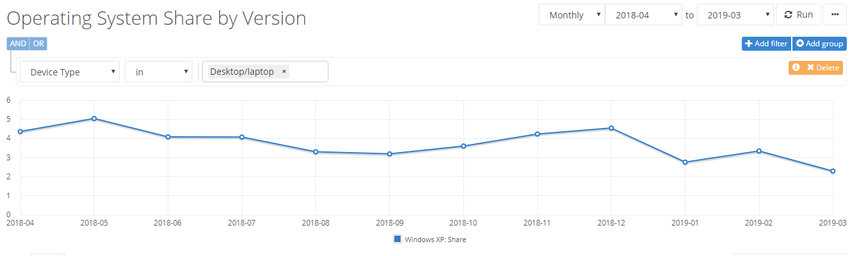
Windows XP is finally dying a slow death, as the 2001 operating system has reached its lowest percentage, which is 2.29%.

And while all eyes are on Windows 10 and the soon-to-be-retired Windows 7, Microsoft is still watching the progress of Windows XP.
And there's a good reason for that: the XP operating system, launched in 2001 and retired in 2014, is nevertheless still surprisingly widely used.
However, according to some new statistics provided by NetMarketShare, Windows XP is finally dying out, after a year of 2018 that was full of ups and downs.
A year ago, Windows XP was running on about 4.59% of desktops worldwide, which for an operating system that was retired four years ago, is quite an achievement.
The strangest thing is that its market share improved in 2018, reaching 5.04% in May, for a reason that is very difficult to explain. Windows XP then followed a downward trend, falling to 3.19% in September 2018, but came back again, increasing the number to 4.54% in December.
Since then, however, Windows XP has been steadily declining, and in March 2019 it reached its lowest market share since its retirement in 2014. The operating system currently holds a share of just 2.29% worldwide, and there is a high chance that its decline will continue in the coming months.
In case you're wondering why anyone would want to ditch Windows XP, the answer lies in the lack of security updates and software support for it. Not only is Microsoft no longer involved in XP's vulnerabilities, but there's also no support for third-party applications, so most of the programs that run on this operating system are already outdated.
And it seems that Windows 7 will follow the same story as Windows XP and will also take several years to completely disappear.
