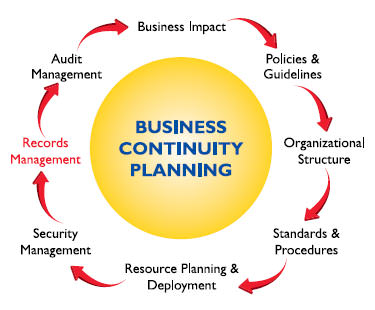
First, let's see what a Business Continuity Plan (BCP) and a Disaster Recovery Plan (DRP) are. As concepts, they may be confusing and considered the same, but in reality, one complements the other.
The Disaster Recovery Plan is the plan that has been developed by the company with specific action guidelines for any possible violent interruption of its operation, while the Business Continuity Plan is the company's action plan for after the disaster and its long-term operation so that it continues to produce work and profit as if nothing had happened.
All of this sounds great, but the reality is completely different. A Disaster Recovery Plan can fail and have an impact on the Business Continuity Plan and by extension the viability of the company.
Starting with the most basic reason a Business Continuity Plan can fail is the lack of understanding of the company during the initial planning. If you do not know the company's organizational chart perfectly (which in many cases they do not even know themselves), if someone has not been designated as a Project Manager to talk to all the company's Departments and departments, if there is no specific Emergency response team, if there are no specific roles and responsibilities for each team member and of course if they are not trained frequently, then the whole project is doomed to fail.
The second reason it can fail is that you are not prepared for everything. Unfortunately, disasters, or categories of disasters if you prefer, are many and there should at least be a guideline for each possible category. If there is not one, Murphy's Law will work! What you are not prepared for will happen and it will happen at the worst possible time, with whatever consequences it will have on the company and its operation.
The next reason is not to include in the planning the communication department or if the company is small, a person who will be the point of reference for all involved and who will manage the crisis as a Project Manager. Everyone should know that this person will be able to talk, arrange, organize and direct the communication, the actions, who should be informed first and much more. Communication is the “key” to the success of a Business Continuity Plan in the event of a disaster.
The fourth reason is the incorrect recording of services based on their importance. The acronym for the recording is BIA, which stands for Business Impact Analysis. We should know exactly which services need to be brought up first and which services can be brought up later. The Business Impact Analysis should be completed before the Business Continuity planning so that the basic services that need to be started initially and the corresponding subsystems that support them can be recorded in detail.
Last but not least, do not frequently update your company's Business Continuity and Disaster recovery plan . It is not something that you create once and that's it. It must evolve along with the company's evolution. Every company is a living organism and so should the planning. If it is not updated, the chances of failure increase because there are too many factors that must be controlled to ensure the smooth operation of the company.