

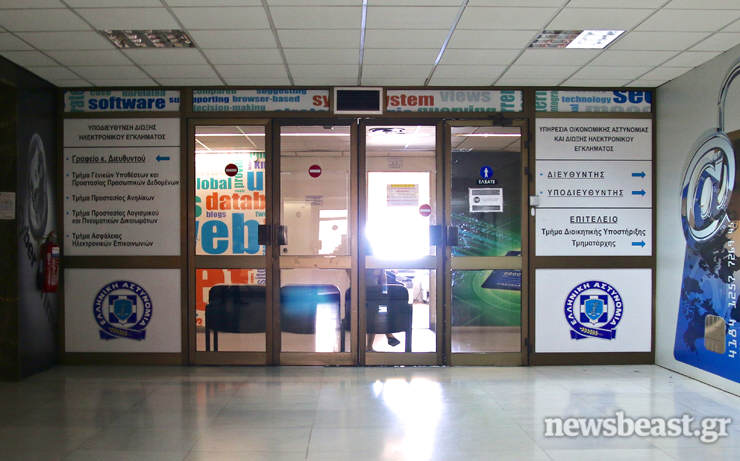
Interview with Major General M. Sfakianakis of the DIE – On the 13th floor of the General Police Directorate of Attica, one encounters a department where the police officers do not wear uniforms and do not have epaulets to indicate their rank. They walk around in plain clothes and spend most of the day in front of a computer. In the office of the head of this department there are four to five computers, portable and stationary, each of them for a different use.
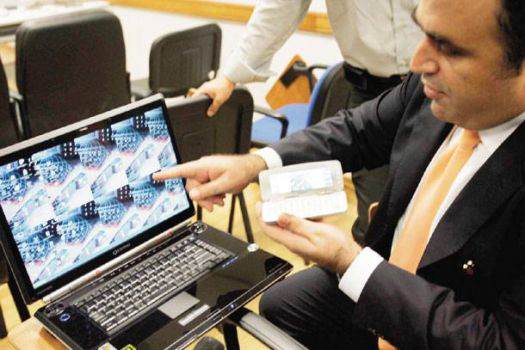
Completely wired, he wears a state-of-the-art watch on his right hand, which even alerts him to the volume of his voice. Major General Manolis Sfakianakis, director of the DIE Cybercrime Unit… is accompanied even in his minimal free time by a laptop. He founded the DIE Cybercrime Unit in 1995 – which evolved into a Directorate -, with the rank, at the time, of lieutenant.
Despite the fact that some initially fought him, considering him a scoundrel who hunted down the ghosts of the internet, stubborn by nature, he succeeded. Restless and restless, he currently leads one of the most successful and efficient cybercrime prosecution services in the world.
Interview with George Lampiris
– General, I would like you to tell me what are the most common criminal acts that you and your service encounter.
"The first thing that concerns us is the safety of our children. Currently, 93% of children aged 13 to 18 use the internet daily. To keep our children safe, we have focused on prevention.
First on the list are crimes of child abuse: child pornography, seduction and everything related to the exploitation of minors. Second come crimes related to social media. Third come financial crimes and fraud, as every day we have dozens of complaints about electronic fraud. Immediately after come the intrusions into critical structures of the country, the so-called cracking. Fifth are the crimes that occur in chat rooms. Where all the criminals of the internet frequent. Drug dealers, pedophiles and all kinds of delinquents. Their “markets” are in the communication “rooms” and at the same time in the Darknet, a chapter that will soon concern police authorities worldwide. 96% of the volume of information is concentrated in the Darknet, while the remaining 4% is what we all see on our screens.
– What has changed since you took over the Prosecution of Electronic Crime until today?
"I took over in 1995, while still a police lieutenant. I came from the Economic Crime Prosecution and my then director asked me - since I had computer knowledge - to take over, in parallel with various seminars that were being held, what we call electronic crime.
At that time, cybercrime was limited to credit card fraud. We had just left the era when some people forged the “chips” of cards and were entering the era when some people created clone cards using computers -in 1997-, stealing the credit card number. Then came the dating clubs, where someone was looking to find a groom or bride. There, every bitter person who had a problem with his girlfriend and wanted to get revenge on her, created a profile on her behalf, saying that he was looking for a man. These were the first illegal acts through dating clubs.
Slowly, cybercrime began to grow, something I had predicted. So I had to prove what I was doing, because no one could have imagined what would happen a few years later. I received strength from God and endured despite the difficulties. Because it is one thing for someone to pursue crime and another to “shout” that there is crime and not be believed. The high-ranking officials at the time did not believe anything I did. Everyone at GADA said that I was daydreaming. My late father had even bought a computer for my service, and everyone knows that.”.
– So you accepted war in your first steps.
"A great war. I do not hide it. The attacks I have received from time to time are a common secret. But I forgive them, as there was ignorance. The logic of those who did not know prevailed, which imposed the elimination of those who knew, in order to survive. I endured, resulting in Greece having one of the best services in Europe. The most important thing, however, is that our country, with honor and pride, exports the product called "successes of the DIE Cybercrime Prosecution"".
– Do foreign countries ask for our help in various cases they face from time to time?
"Our results are such that they force foreigners to bow before us. When you see the company Facebook make a public post on 1,300,000,000 user profiles, sending congratulations to the Hellenic Cybercrime Investigation Department, DIE, that says a lot.".
We managed to stop the Lecpetex virus, which was created by two Greek hackers, blocking the entire Facebook system. We discovered them, saving the company from several hundred million investments in order to escape this virus. Those who know about us, got to know us through our successes. At first we were hidden. But when my proposals – in 2010 – to the former minister, Michalis Chrysochoidis, started to be heard, and we hired 100 scientists for cybercrime, I was already looking ahead.
I had even told him: “Minister, without scientists we are finished, I am leaving, I will not sit as the only native to save the lot”. The police officers are good and golden, but if someone does not have diplomas and specialization, they do nothing today. These scientists have been hired after a targeted announcement, in search of specific qualifications and degrees. We are perhaps one of the few services of the Greek public that have ISO”.
– How do you deal with the hackers you occasionally arrest? Do some of them join the service, as is the case with several foreign agencies?
"Hackers are intelligent scientists. Therefore, our service does not close its doors to anyone. We all have the right to make mistakes. That's why people who made a mistake in the past and then came to work here are useful.".
We are a service that opens its arms to society. In the month of May alone, 30 conferences were organized alongside our other duties. We work all day, every day.
At this point I will tell you something shocking. If someone had said four years ago, "I'm going on a field trip to GADA," most people would have thought they were telling a joke. Today, school buses are crowded on Alexandras Avenue, full of students who come to the DIE Cybercrime Investigation Unitto visit us and see how we work and what exactly we do."
– What is Cyberkid?
"This is a website that was created after we investigated a major case. There was a game in which nine-year-old girls could dress up their dolls. Pedophiles seduced underage girls through this game. So I felt the need, as the head of a service, to build a portal with games and advice, while we have also obtained the rights to "dress up dolls". So, girls can dress up their dolls through the website of the Greek Police.
In fact, we have already won two gold medals for the patent we have implemented through Cyberkid. By pressing a single button, Cyber Alert directly rings our offices.
"As for Cyber Alert, we are also preparing an innovation. We are building an application, creating the special Cyber Alert network. From there, any form of risk will be directly channeled to our officers. We estimate that we will launch it within the next 20 days.".
– Despite your warnings, many parents allow their underage children to upload photos to Facebook or elsewhere, and many times they even upload them themselves. Ignorance of the danger?
Those parents who continue to upload photos despite our warnings obviously think that what we say is nothing more than “little stories”. The last one we arrested was taking photos of girls from Facebook, editing them into a pornographic video and then blackmailing minors. “If you don’t give in to what I tell you, I will publish the video on Facebook , in which you star, and your parents, friends and everyone you know will see it”, said the specific one we recently arrested”.
– On June 16, the "Perseus" program will begin for the first time in Europe, starting in Greece. Tell us about it.
"We have built a strategy, which I presented to the European Union and everyone said: 'Greece is ahead!'" For this reason, the Europeans gave us the opportunity to be the leaders for 2015 in terms of informing the European public about the security of trade and transactions via the Internet. The specific initiative that we have been implementing since the beginning of 2015 will culminate on June 16, as Greece, based on this, will have secure airports 365 days a year, implementing the "Perseus" program. We will be the first country in Europe to check airport security daily for transactions with lost, stolen or fraudulent cards. At the same time, Europe only carries out the relevant exercise twice a year. However, we, Helladitsa, as some people tell us, are implementing the "Perseus" program at all airports in the country throughout 2015.
Thus, the 25,000,000 travelers expected to pass through Greece will be able to be completely safe based on the program in which airlines and travel agencies will be included. Thus, after the transaction has passed through the electronic system, the malicious customer is checked, filtered and identified. For example, we will be able to give an order to Mytilene, saying: “Catch this person”, and then the Police will proceed with an inspection if there is suspicion of fraud. Based on the analyses we do, we are showing an 82% success rate in identifying fraud cases. Among the suspects are often people who do not have travel documents and the inspection shows that they have falsified their papers in order to be able to travel abroad without any problems.”
– What is the most difficult and perhaps the most important case of your career?
"In my 20 years of career, I have encountered many difficult cases. One of them touches me personally but also my entire service. I am referring to the case of the disappearance - kidnapping of 13-year-old Despina. The girl had disappeared and everyone had written her off. At the same time, the amber alert did not offer any information about her. Ultimately, the information came through the persistence and patience of the people of the DIE Cybercrime Investigation. After a lot of struggle, we detected a trace for a few seconds in an internet cafe.
Prosecutors went to the scene and spoke to the owner of the cafe. Showing a photo of the girl, the shopkeeper remembered that he had seen her a few hours earlier. We combed the entire neighborhood to reach an old woman, who told us: “The girl you are looking for must be at this door”. I immediatelycontactedprosecutor Korre, who was off duty. However, when he heard that I was looking for a prosecutor so that we could search the house, he immediately agreed to serve us. Entering the house we see 8-10 dark-skinned people, a fight ensued and while searching the house we found the girl locked in a closet.
– You told me that you found a trace of Despina, which helped you understand that she was alive. How important are electronic traces?
"You should know something. Many people tell people that they remain anonymous when they use the internet. But there is no anonymity on the internet. We are all anonymous and when everyone logs on to their computer, they have an electronic trace. This trace - IP address - accompanies them everywhere, wherever they go. Some cunning people claim that they can change the trace and mislead the police. I answer them that if they knew how to do it, such prominent hackers would not have been arrested.".
– If I upload a photo online and download it again, is it lost?
"It never disappears. Neither the trace, nor the photograph.".
– Therefore, it is an illusion that some people think that if they delete a photo from Facebook, it disappears.
"Of course it's an illusion. There are machines that store our every move on the internet every second. And perhaps many people don't know this. In short, what goes up on the internet never comes down.".
– If I write on Facebook “I want to die,” is that a sign that will ring a bell in your service?
"Depending on what follows, it is an indication to approach this person with a psychologist. Based on his profile, an internet search is carried out, always with the order of a prosecutor.".
So far, however, we have saved 1,212 of our fellow citizens from suicide. A typical case was the case of a minor, whom we located in 8 minutes, while she was trying to commit suicide. We went to her house with the DIAS team and met her parents. When we asked them - it was three in the morning - where their daughter was, they replied that she was in her room and sleeping. A short time later, the mother entered the room, saw her child injured and began to cry for help. We immediately took the girl to the hospital, and for this incident we were awarded by the FBI.
– What is the profile of the people who posted abusive messages against little Annie when the little girl went missing?
"This case is still ongoing. However, their profile is similar to those who cursed Giakoumakis on the day it became known that he was found dead. On the same day, some of our fellow citizens were vulgarly and brutally cursing this man.".
– We've heard the word bullying a lot lately. But has there been any confusion about what it exactly is? For example, if someone calls me "fat" during a break at school, does that mean they're bullying me?
"Some people want to criminalize the smile of our children. But we will not let them. Some, after the unjust loss of Vangelis Giakoumakis, want to convey to society that we are a country full of bullying cases. With this reasoning, we should have arrested half of Greece because Elenitsa does not talk to Giorgakis, Giorgakis to Manolakis and Manolakis to Kostakis. A simple tease, a joke or a misunderstanding, some want to call it bullying. But that is not the case.
Bullying is something completely different and I will give you an example. One of the incidents we dealt with involved a sixteen-year-old girl. Some people stole her photos, edited them and uploaded an erotic video on Facebook, using her photos. This girl made 3 suicide attempts in 22 days. This is bullying. From the research we did afterwards, we found that behind this was the second student in the class, who wanted to be first. When someone does not understand where the teasing stops, then the bullying begins.
Making fun of someone by saying, “You’re fat or you have big ears” doesn’t have the same dimension as what I just mentioned. But we need to know when the joke stops. If the school principal tells a child, “Stop now,” the children need to listen to him. The line between a joke and terrorism is very thin. Don’t forget that everything in life starts with a joke.”.
Source: newsbeast.gr
