

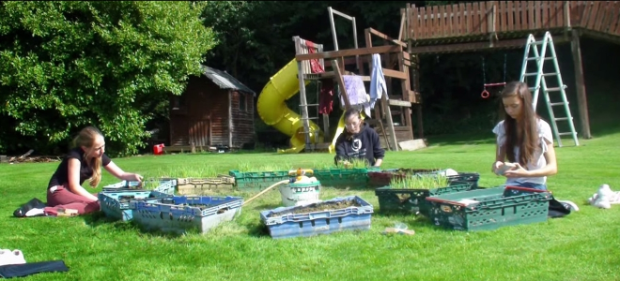
They started by playing with their garden and paved the way for solving global hunger. The story of three 16-year-old girls who won the Google Science Award.
The garden belonged to the then 15-year-old Emer Hickey, one of the three girls who decided to explore possibilities for increasing crop yields without using synthetic fertilizers.
After 10,000 seeds, 120,000 experiments and a year later, the mini-microbiologists won the first prize at the Google Science Fair 2014.
Heike, Kiara Janz and Sophie Hayley began to be interested in finding an applicable solution for the looming global food crisis as early as 2011, studying hunger in Africa.
At that time the girls were only in seventh grade, but they already behaved like world-class scientists and their résumés included a series of national and international awards in science competitions throughout Europe.
When Hikee pulled the peas from her garden, she noticed strange pods emerging from them. The girls quickly realized that the pods were home to natural bacteria that help boost the growth of peas and other members of the legume family.
The idea for the big project that was awarded is incredibly simple. The girls decided to see if they could take these bacteria, known as rhizobia, and introduce them into other types of crops for a similar result.
The result, as detailed in their work, «Combating the Global Food Crisis: Diazotroph Bacteria as a Cereal Crop Growth Promoter» was astonishing. The bacteria acted as a kind of powerful natural fertilizer for the plants.
Indeed, the girls observed that the use of bacteria in cereal crops, such as oats and wheat, reduced the germination time by between 13% and 50% depending on the seed type, and the overall yield of the crops increased by 75% relative to the dry mass of the crops.
The girls won the top prize, standing out among thousands of participants aged 13-18, who showcased technological marvels such as flying robots and portable technologies for patients with Alzheimer's.
For their research efforts, Janj, Hickey and Heili received a $50,000 grant from Google, along with a 10‑day visit to the Galapagos Islands, funded by National Geographic.
