

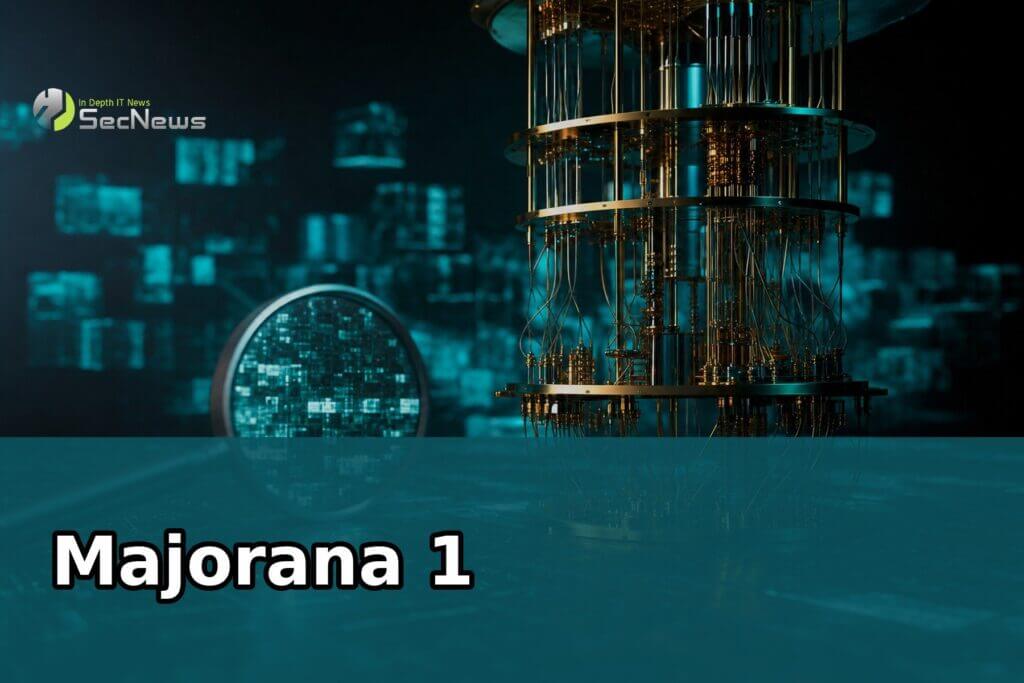
Majorana 1 , the quantum chip that Microsoft unveiled in February 2025 as a “revolutionary” technology, is at the center of serious scientific controversy. A peer-reviewed review published in the prestigious scientific journal Nature disputes the company’s claims, arguing that Majorana 1 did not convincingly demonstrate the operation of a topological qubit — the technology that is the cornerstone of Microsoft ’s quantum strategy . The controversy comes at a crucial time, as the company just announced its successor, Majorana 2 , at the Build 2025 conference .
See also: Microsoft and allies destroy Amadey and StealC's shared infrastructure
Physicist Henry Legg of the University of St. Andrews reexamined Microsoft ’s data and came to some troubling conclusions. According to Legg, the experimental signals that the company attributed to topological qubits could just as well be explained by conventional quantum dots — structures that contain electrons but are not useful for building a quantum computer. In addition, the researcher accused Microsoft of selective data presentation, while also identifying programming errors in the software tool the company used to validate its research, which produced “ inconsistent and erroneous results .”
In 2018, the company was forced to retract a paper it published in Natureclaiming to have discovered Majorana particles, citing insufficient evidence. Legg doesn’t hesitate to place the current findings in that broader context: “There’s nothing in this paper that proves that this is a qubit… I think this is just another step in Microsoft’s nearly decade-long history of unreliable results.” Regarding Majorana 1,
Majorana 1 and 2: What Microsoft claims and what critics say
Majorana 1 's architecture is unique in the industry: it uses a tiny wire made of the semiconductor indium arsenide connected to a superconductor. Theory predicts that the electrons in this wire will behave like Majorana particles, which Microsoft plans to use to encode information. A topological qubit based on Majorana particles is attractive because it promises fewer errors compared to competing technologies, such as the superconducting qubits used by IBM — meaning fewer qubits would be needed to scale the computer to a practical level.
See also: PACT: Cloudflare, Google, Mozilla and Microsoft bring new verification standard

At its Build 2025 conference , Microsoft announced Majorana 2 , claiming it is 1,000 times more reliable than its predecessor, with qubit lifetimes jumping from 1–12 milliseconds to around 20 seconds — and in some cases up to 1 minute . In addition, the topological gap , which protects qubits from external noise, is reported to have more than doubled . However, Legg points out that the new, non-peer-reviewed manuscript for Majorana 2 suffers from the same fundamental problems as its predecessor.
The scientific community largely agrees with Legg's reservations. Vincent Mourik of the Research Centre Jülich in Germany pointed out that the device only demonstrates parity state preservation, not qubit control — something that is necessary for true quantum computing. Sergey Frolov of the University of Pittsburgh, a well-known critic of Microsoft in this field, said: "Microsoft's quantum project follows a long pattern of unsubstantiated claims... Even if they achieved Majorana states, there is no evidence that their device actually functions as a qubit."
Microsoft responded by also publishing an official response in Nature that disputes Legg's arguments. Jason Zander , Microsoft Quantum 's Executive VP , said the company " stands by its results 100 percent " and said it is sharing data with the US defense agency DARPA for independent evaluation. The outcome of that evaluation could prove decisive: if DARPA confirms the existence of topological qubits , it will significantly strengthen Microsoft 's position ; if not, the project will face a serious setback.
See also: Microsoft integrates Affinity into new Surface devices
In the broader quantum computing landscape, companies like Google and IBM have already demonstrated machines with more qubits than Majorana 1 or 2, using different technologies. However, no quantum computer has yet performed any practical work at commercial scale. Microsoft CEOSatya Nadellahas spoken of a “clear path to a million-qubit processor,” and the company’s goal for a working quantum system is set for 2029 — a timeline that critics say is impossible to meet, given the lack of evidence of working qubits. For enterprise users exploring quantum cloud services through Azure Quantum, the reality remains that current offerings are still experimental, with no immediate practical utility for complex applications like drug discovery or cryptography.
