

Two British scientists studying satellite images and data from an ancient crater on Mars say they have found evidence of microbial and bacterial life beneath its surface. The two researchers believe their findings are the strongest evidence yet of life on the Red Planet.
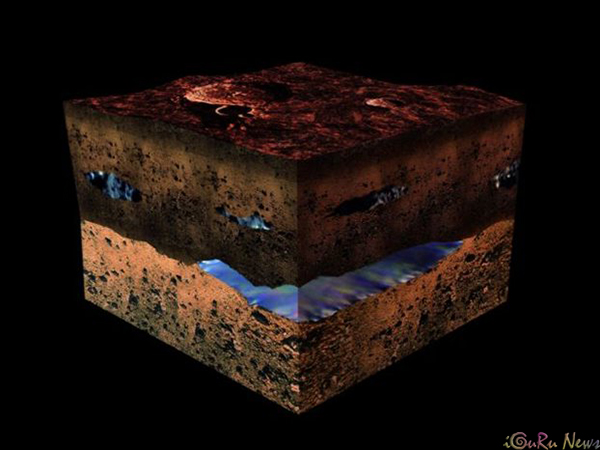
The rocks and the lake
John Parnell, a professor at the University of Aberdeen, and Joseph Michalski, a planetary geologist at the Natural History Museum in London, studied the MacLaughlin crater, a 97 km diameter and 2.2 km deep crater that is one of the oldest on Mars.
By studying images and data sent back by the Mars Reconnaissance Orbiter (MRO) satellite orbiting Mars, the two researchers concluded that a lake had formed in the crater about 4 billion years ago. More specifically, the researchers studied the composition of rocks in the crater that emerged to the surface after the asteroid that created it fell.
The theory
According to the researchers, the chemical composition of the rocks was changed by the presence of water, which is one of the most critical factors for the existence of life. This change, as the two scientists estimate, took place when the rocks were still in the subsurface. They believe that in the subsurface of Mars there were and probably still are all the conditions necessary for the emergence and maintenance of life. They also believe that the crater was filled with water that was present in the subsurface and not with water that fell into it from some external source.
"We know that there are many forms of life in the Earth's subsurface. The study of MacLaughlin Crater reveals that the conditions in its subsurface have many similarities to those in the Earth's subsurface. Life cannot exist on the surface of Mars since the planet is constantly bombarded by radiation while at the same time very low temperatures prevail. However, the subsurface offers protection from these unfavorable conditions. There is no reason why bacteria or microbes should not live in the subsurface. We estimate that life forms found in the subsurface of Mars do not need hydrogen to survive, as is the case with microbes that live in the subsurface of Earth. Unfortunately, we are not going to find animals in the subsurface of Mars since even in the Earth's subsurface, the most complex life forms that exist are fungi. "But fungi are complex life forms and it is not impossible that such small but complex life forms exist on Mars as well," says Parnell.
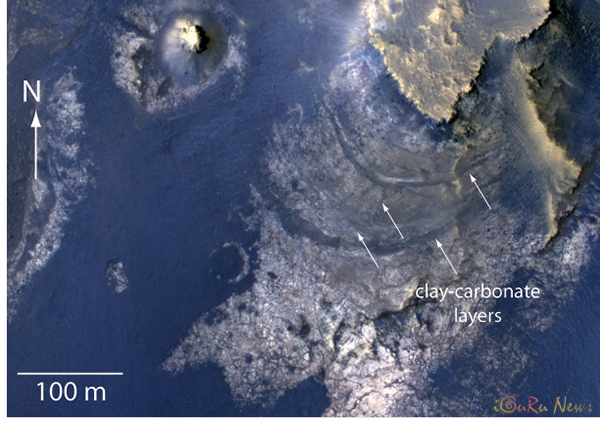
Satellite image of MacLaughlin Crater. Arrows in the image mark the locations of rocks whose chemical composition was altered by water in the interior of Mars.
The detection
The two researchers believe that future missions to Mars should "visit" MacLaughlin Crater and dig into the ground. They even point to its rim as a place where the chances of life below the surface are increased. The researchers believe that, among other things, the results of research in the subsoil of MacLaughlin Crater or in other craters will help us learn new information about how life began on Earth.
"Although we all live on the surface of the Earth, life did not begin here but in the subsurface. When life in the subsurface became stable, it began to move towards the surface. By studying life in the craters of Mars, we are discovering evidence of how life began on Earth," says Parnell. The research is published in the journal Nature Geoscience, with the two researchers stating that they will soon be able to say with certainty whether there is now or was once life on Mars.
