

Researchers at Imperial College London and Empa have built a drone, called FireDrone, which can withstand very high temperatures, so it is able to enter burning buildings and areas.
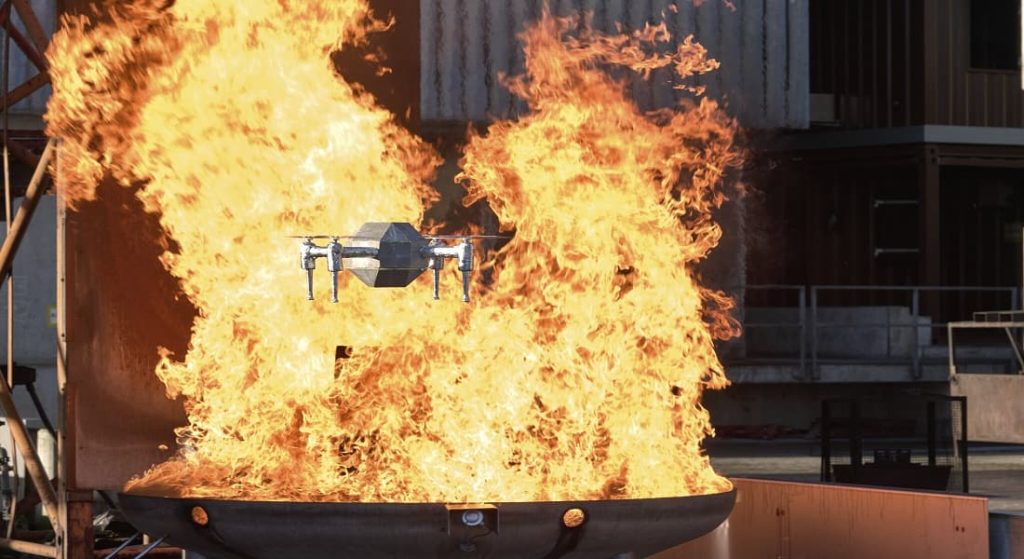
This prototype drone could be sent into burning buildings or forested areas to assess the risks and provide critical data to firefighters and people who want to help.
The drone is made of a new thermally insulating aerogel material and features a system cooling that helps it withstand temperatures of up to 200°C for ten minutes.
Principal investigator, Professor Mirko Kovac, Director of the Aerial Robotics Lab at Imperial College London and Head of the Laboratory of Sustainability Robotics at Empa, said of the FireDrone prototype: “Until they enter the danger zone, firefighters cannot be sure what or who they will find and what challenges they will encounter.”
See also: Orqa: Drone glasses maker says firmware breaks device
According to the expert, the FireDrone could be sent in advance to collect critical information. For example, it could locate trapped people or animals, check the layout of buildings, or identify other unexpected hazards. This way, firefighters and rescue teams can prepare appropriately, depending on the conditions.
Inspiration from animals
Drones are already used in firefighting to take aerial videos, lift fire hoses up skyscrapers, etc. However, most of today's drones cannot fly too close to the fire, as there is a risk of melting their frames and damaging their electronics.
According to interviews with firefighters, however, it is important for drones to be able to get close to the fire to help prepare rescue teams for entry into burning buildings or forested areas. Drones equipped with cameras and sensors carbon dioxide (CO2), for example, could provide critical information about the layout and composition of fires.
Researchers created the new FireDrone drone, inspired by animals that live in extreme temperatures such as the penguin, the arctic fox, etc. All of these have appropriate layers of fat, fur, or produce their own layers of thermoregulatory material that allow them to survive in extreme conditions.
See also: Can hackers take control of a DJI drone?
To build the drone, the researchers created a protective shellmade of lightweight, thermally super-insulating materials such as aerogel and fiberglass. They coated it with super-reflective aluminum to reflect heat. The super-insulation prevents the materials from shrinking after exposure to extremely high temperatures.
Inside the protective exoskeleton, temperature-sensitive components such as regular and infrared cameras, CO2 sensors, video, flight controllers, batteries , and radio receivers. As mentioned above, there is also a built-in cooling system to keep the temperature low.
Testing the FireDrone drone in extreme temperatures
The researchers tested the drone in temperature-controlled chambers and flew it near flames at a training to test its durability. They are already working on a smaller version, and want to add more sensors.
See also: Far-UVC light: New lighting technology kills pathogens in the air
It's worth noting that the FireDrone can also be used in extremely cold environments. The team has tested it in a glacier tunnel in Switzerland to study how the system behaves in very low temperatures.
For now, the FireDrone is in the development stage, but researchers say it's a step forward for developing other drones that can withstand extreme temperatures.
Heat-resistant drones are revolutionizing the drone industry. Their ability to operate in high temperatures without affecting their performance makes them an excellent investment for many industries and disaster relief.
Source: www.imperial.ac.uk
