

The U.S. Department of Justice (DoJ) announced that a 25-year-old Colorado man named Bryan Connor Herrell has been sentenced to 11 years in prison for operating the dark web marketplace “AlphaBay.” Specifically, court documents state that between May 2016 and July 2017, Herrell operated as the marketplace’s administrator and scam watcher, under the aliases “Penissmith” and “Botah . ”
During this time, Herrell settled over 20,000 disputes between sellers and buyers and was paid in Bitcoin for services by the owner of AlphaBay. Herrell was charged with racketeering, as shown in an indictment filed in December 2017, and pleaded guilty on January 27, 2020. The court sentenced him to 11 years in prison, although after pleading guilty, he faced a maximum sentence of 20 years.
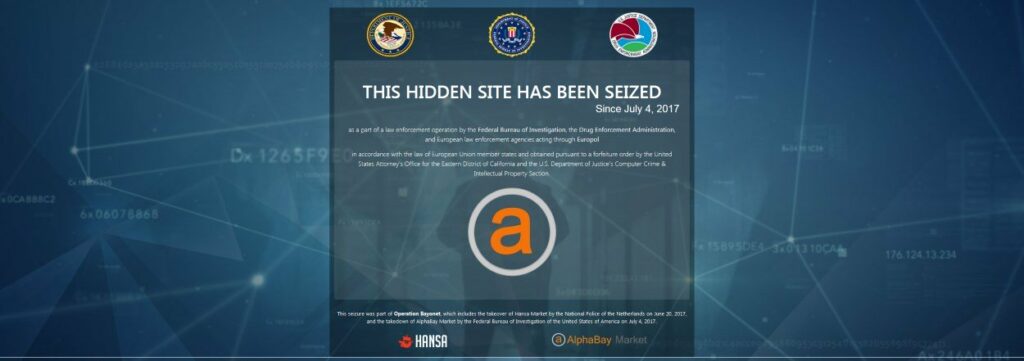
The sentence comes after a massive operation by the FBI, DEA, Europol and local authorities from several countries that secretly took control of the popular dark web marketplaces “AlphaBay” and “Hansa,” which were among the largest dark web marketplaces, with the former generating an estimated $500,000 per day. Their sudden disappearance left a huge void on the dark web – a void that was filled by other similar platforms a year later.
Additionally, AlphaBay’s creator, Canadian Alexandre Cazes, died in prison. Cazes was arrested at his home in Bangkok, Thailand, in June 2017 by the Royal Thai Police, with the assistance of the FBI and DEA. His identity was discovered by the FBI after several OpSec, including the use of the AlphaBay administrator’s personal email to deliver welcome messages to new members on the AlphaBay forum. Cazes managed to earn over $23 million in cryptocurrency while operating AlphaBay, and held real money in various bank accounts in Thailand, Liechtenstein, Switzerland, and St. Vincent, among others. Thai authorities also seized approximately $12.5 million worth of cars and real estate following Cazes’ arrest.
Upon his arrest, police found laptop open and unencrypted. Agents and officers found numerous text files that identified passwords/passkeys for the AlphaBay website, AlphaBay servers , and other online identities associated with AlphaBay.
According to a press release issued by the DoJ, AlphaBay remains under investigation until all former market operators are found and convicted, even though Cazes' indictment was dropped after he was found dead in his cell a week after his arrest on July 12, 2017, where he was being held on drug-related charges at the request of US authorities.

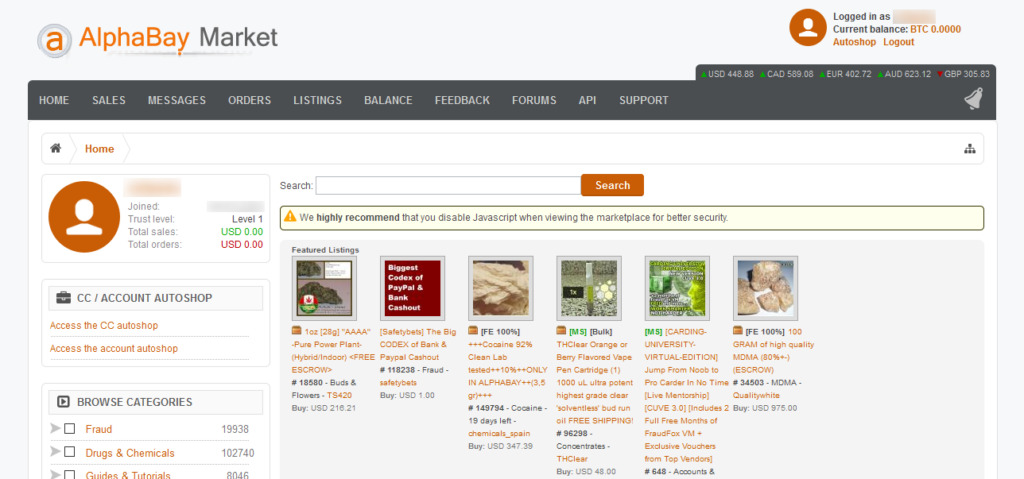
On AlphaBay, sellers and buyers made hundreds of thousands of illegal transactions for weapons, drugs, stolen IDs, credit card numbers and other illicit items, the DoJ said. AlphaBay was considered the largest online drug marketplace, with FBI Director Andrew McCabe saying it was ten times larger than Silk Road, with more than 200,000 users and about 40,000 vendors.
According to Europol, there were over 250,000 listings for illegal drugs and toxic chemicals on the dark web marketplace “AlphaBay” and over 100,000 listings for stolen and “fraudulent” identification documents and access, counterfeit products, malware and other hacking tools, firearms and “fraudulent” services. It added that, by a conservative estimate, AlphaBay processed $1 billion in transactions from its inception in 2014 until its closure, with transactions paid for in Bitcoin and other cryptocurrencies. In addition, the marketplace’s servers were seized by authorities in Canada and the Netherlands, while millions of dollars worth of cryptocurrencies were also “frozen” and seized.
AlphaBay was taken down on the dark web after a joint law enforcement operation, known as “Bayonet,” in July 2017, in both Canada and Thailand.
