

A team of archaeologists working in southwestern Spainhas discovered a Bronze/Iron Age stone tombstone with detailed relief designs depicting gender and social roles in prehistoric times. The discovery has excited the team and the results are expected to be quite impressive.
See also: New images: Neanderthals were much more like us than we think
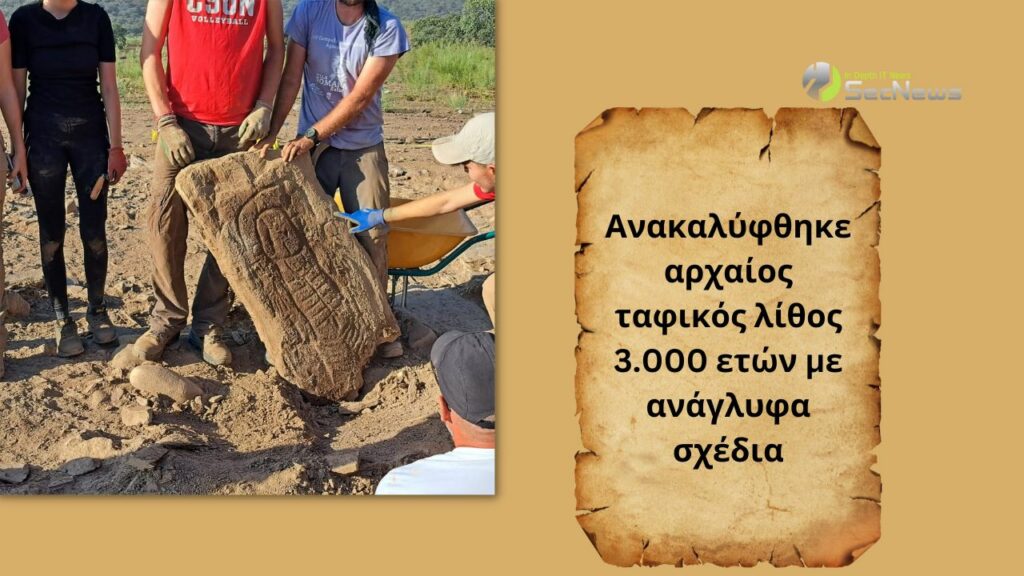
The excavation is taking place at the 3,000-year-old ancient burial complex of Las Capellanias, in the municipality of Canaveral de León, Spain. Here, researchers have discovered an ancient stele, an upright burial stone with relief designs that indicate that the site belongs to important individuals. Essentially, it is a type of tombstone, although sometimes they could also be used as offerings or souvenirs.
On this particular stone, a human figure is depicted with a carefully carved face, arms, and legs. The figure appears to be wearing a crown and necklace – symbols traditionally associated with the female form – yet it also holds two swords and has male genitalia.
See also: Papyrus containing the Egyptian Book of the Dead found next to mummies
The combination of these features on the tombstone has led archaeologists to revise their understanding of gender as represented by these relief designs, which may have been more flexible than previously assumed. It appears that such symbols were not necessarily limited to a specific gender.
This is not the only stele found at this site. So far, archaeologists have discovered two other stones that provide valuable information about burial rituals from this era.
The site of the Las Capellanías cemetery is located on an important natural path connected to a river estuary.
See also: 2,300-year-old tomb excavated: Woman who followed Alexander the Great's army discovered
The team believes that the location of Las Capellanias on such an important road is significant in itself. It is possible that the columns also functioned as territorial division markers rather than just tombstones.
Source: iflscience
