

It could be the end of the keyboard or even the pen. The airwriter, or the glove that allows you to write messages in the… air, is now a reality and comes from researchers at the Karlsruhe Institute of Technology, in Germany.
With the help of sensors and gyroscopes integrated into the glove, the revolutionary accessory can “read” the movements of the user’s hand. So during the “writing in the air” the glove’s advanced system translates the movements into letters, ultimately forming words.
The ultra-sensitive sensors record the user's hand movements, which, with the help of Bluetooth technology, are wirelessly transferred to a computer in the form of signals. There, they are processed and finally translated into words.
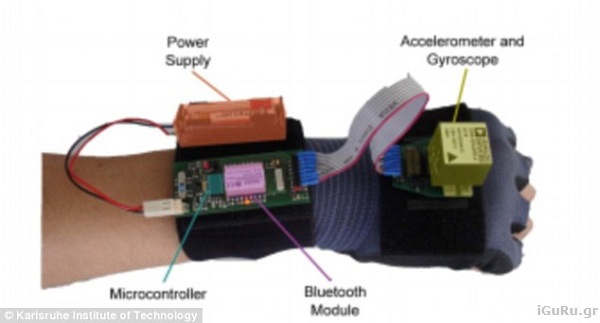
The future of "invisible" communication
For each letter of the alphabet, the system creates a statistical model based on the movement pattern it records, thus learning the way its owner "writes". Each model corresponds to a letter, resulting in all the letters together forming words. Furthermore, the "smart" system is able to distinguish when the user is waving their hand because they want to write in the air and when they are waving it for other reasons.
According to its inventors, the airwriter could be used to compose messages and emails. " Airwriting can be used to write words in the air, as if we were writing on an invisible whiteboard," explains doctoral student Christoph Ama .
This particular technology, he estimates, could in the future be incorporated into "smart" clothing that would allow its owners to compose messages anywhere and anytime, without the need for additional equipment.
“Interactivity could be integrated into our daily lives,” he emphasizes. “The movements we make with our hands – e.g. cooking, cleaning, greeting – are not the same as the movements of writing. The airwriter’s smart system is constantly “running” so it knows which movements represent the letters of the alphabet,” Ama adds.
"The overall error rate of the system at this stage is 11%, however, once the system adapts to the user's writing style, this rate is reduced to just 3%," the researcher concludes.
The inventive young man and leader of the effort recently received the Google Faculty Research Award from the American giant Google, which translates to approximately 60,000 euros, which reinforces rumors about the development of a companion accessory for the hi-tech Google Glass glasses.
The German scientists' aim now is to shrink the "air writing" system in order to create an easy-to-use, stylish and affordable communication accessory.
