

When most people think of invisibility cloaks, they think of something out of Harry Potter, wearing a fabric that makes you blend in with your surroundings. This might help you sneak into the restricted section of your school library, but it won't fool radar.

A team of engineers at Iowa State University has published a research paper detailing the use of flexible metamaterials – artificial materials that have properties not found in nature – to hide objects from detection by microwaveradar .
The team called the radar-absorbing metamaterial a "meta-skin," which consists of a matrix of liquid metal split-ring resonators embedded in layers of silicone rubber. The liquid metal alloy is a mixture of gallium and indium called galinstan, which remains liquid at room temperature but is not toxic like mercury. These split-ring resonators work by absorbing radar waves within specific frequency ranges.
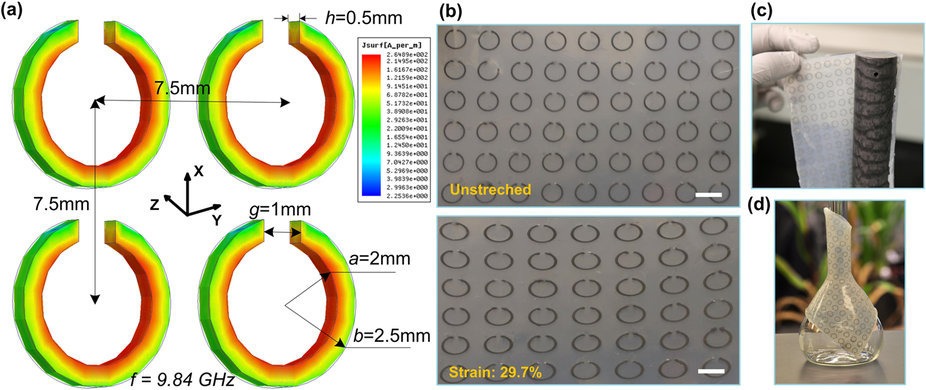
By making these resonators liquid and embedding them in a flexible material, the team has essentially created anti-radar sheets that can be placed on any object. While they don't absorb all radar waves, tests showed that about 75% of radar waves originating in the 8-10 GHz range were absorbed by the meta-skin wrapped over the surface of a rod.
Common radar suppressors cut backscattering, which occurs when radar waves hit an object and bounce back to the transmitter. The “meta-skin” goes one step further than that – it cuts into waves that scatter at different angles.
The flexibility of the resonators also allows them to be easily tuned to absorb different frequencies. Through stretching and spacing, the team was able to tune the frequency up to 9.15 – 12.38 GHz. They don’t want to stop there, though.
“The long-term goal is to shrink the size of these devices,” Liang Dong, who worked on the research, told Everything RF. “Later, we hope to be able to do this with higher-frequency electromagnetic waves like visible or infrared light.”
