

In an era where images created or modified with artificial intelligence are becoming increasingly difficult to distinguish from the real thing, Apple is trying to change the rules of digital photography. iPhone 18 Pro and iPhone 18 Pro Max support the new Apple Reference Image, a technology designed to confirm whether an image actually came from an iPhone camera and whether the original capture data was intact.
Apple describes the technology as a way to create a digital “negative”that can act as evidence of a photo’s provenance. The goal is not just to prove that an image was created with a smartphone, but that it was captured by a real sensor at a specific point in time and is not entirely the product of AI or later digital manipulation.
A new level of authenticity for digital images
The need for such technologies is becoming more acute as the use of generative AI tools increases. A photo can now be created from scratch or heavily modified in a matter of seconds, making visual assessment alone not always a reliable way to check.
See also: Insecure Direct Object Reference (IDOR): What it is and how we can protect ourselves
Apple Reference Image attempts to address the problem at the hardware level. Instead of authenticating a photo after the operating system and apps have finished processing it, the process starts with the camera sensor.
In this way, Apple wants to create a reliable and scalable authentication method that can answer a crucial question: “Did this image actually come from a real camera sensor?”
The signature is made immediately after receiving
The technology puts the camera sensor into a special reference mode. Once the shot is taken, the pixel data is cryptographically signed directly by the sensor.
Of particular importance is the fact that the sensor firmware is prevented from modifying the data after it has been signed. This is a significant difference compared to approaches where authentication occurs at the end of the processing chain.
Apple argues that such an architecture significantly limits the scope for tampering with the original data before it acquires a cryptographic identity.
Alongside the normal photo that the user views and edits, a separate, protected reference copy. This includes the original pixel data, sensor-related information, and cryptographic timestamps with defined time limits.
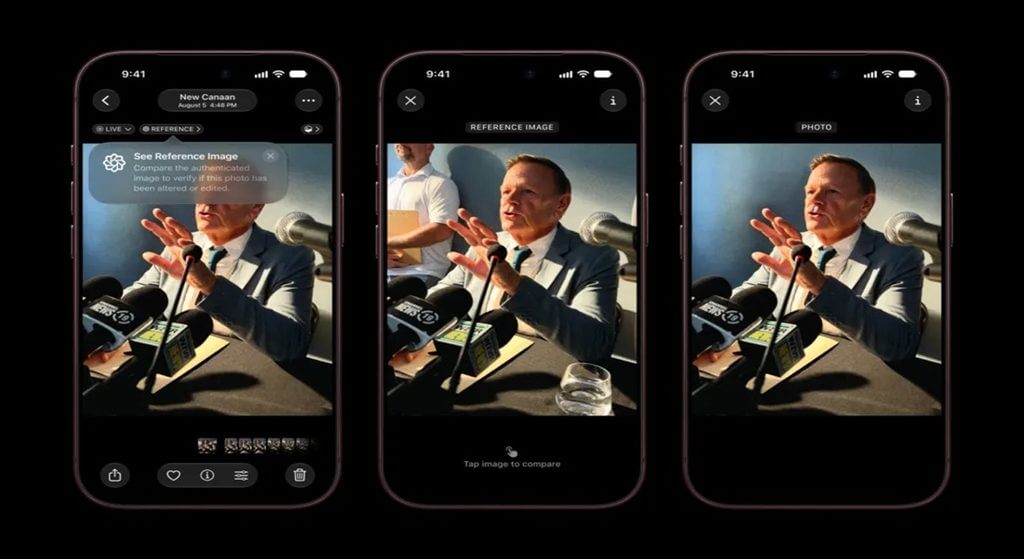
The "negative" remains protected from interference
The digital negative is stored on the device until the user chooses to use it for verification. At that time, it is transferred unprocessed to the Private Cloud Compute, which is designed for tasks that require cloud infrastructure without unnecessarily exposing user data.
There, the necessary steps for rendering the image and checking it are carried out in an environment that Apple describes as secure, private, and verifiable.
This approach is of particular interest to journalists, photographers, researchers, and organizations that need to prove the provenance of visual material. In an environment where a photograph can be a crucial piece of evidence, the ability to verify the original recording can be of practical value.
See also: Apple explains how Siri will work with Gemini technology
Protection against different types of attacks
According to Apple, the system is designed to address a range of different threats, including data entry attacks, compromised operating systems, hardware-level attacks, and attacks targeting cryptographic infrastructure.
The company also claims that Apple Reference Image is the only image origin certification system that has defenses designed to be resistant to quantum threats.
Another interesting feature is the revocation. If a violation or attempted fraud is detected, the system can revoke the credibility of specific photos or, in more serious cases, even an entire sensor.
Private Cloud Compute calculates a trust score for each image, offering an additional mechanism for evaluating its origin and integrity.
Privacy remains a key priority
Apple has also built into the system mechanisms aimed at protecting photographers. Apple Reference Image does not rely on public, immediately identifiable credentials that could link a photographer to all of their images.
At the same time, it avoids the public association of different photos taken by the same sensor. In this way, the technology attempts to offer authentication of origin without creating a new system for monitoring user activity.
Apple claims that the image is even protected by the company itself, an element that becomes particularly important when verification is carried out via cloud infrastructure.
See also: Rivian: CEO explains why vehicles don't have Apple CarPlay
Optional feature with specific limitations
Apple Reference Image is not mandatory. The user must choose to enable it, while the function is limited to the main camera sensor.
Apple's choice to make the feature optional suggests that this is more of a special-purpose tool than a mandatory change to how the iPhone photography experience works
More importantly, however, is the direction this technology is taking. As the production of synthetic images becomes increasingly easier, the next great challenge for photography may not be creating a stunning image, but proving that it actually happened.
With the Apple Reference Image, Apple attempts to move the concept of authenticity from simple viewer trust to a technically verifiable level, creating a kind of digital negative for the age of artificial intelligence.
