

MIT: How do ants decide where to move their nests? Could this question be taught by one of the world's leading technology universities? Computer scientists are looking for efficient ways to collect data from distributed sensor networks, and according to MIT researchers, ants can help.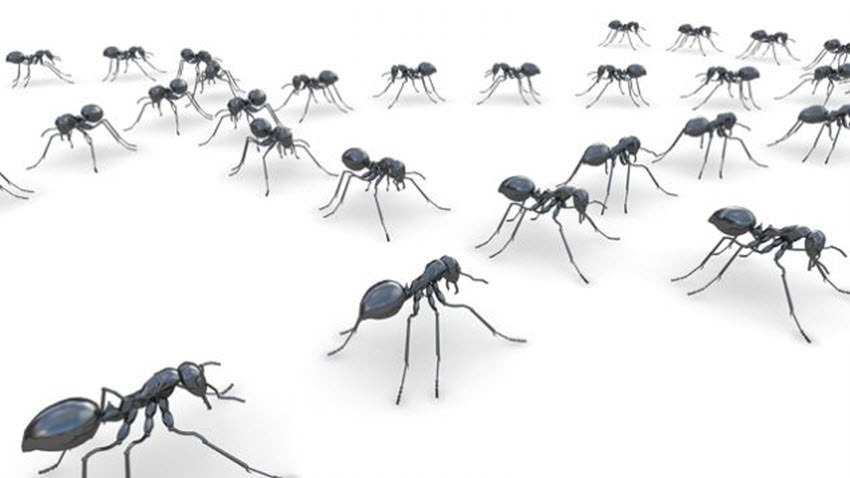
It turns out that the frequency with which ants explore and collide with each other as they wander around looking for a new colony is a very good indication of how researchers should search.
When many ants gather in a nest, workers in the ant colony lift the queen and carry her to the chosen location, says Cameron Musco, a graduate student at MIT in the department of electrical engineering and computer science.
The researcher and his team examined the mathematics behind ant behavior in search of an efficient way to estimate population density.
Roaming and potential collisions in what researchers call random walks gives ants a sense of how much a critical mass of other ants are interested in founding a new colony.
Musco and his colleagues simulated the behavior of ants “with a mathematical model of random walks in which a region is divided into a grid of nodes, and each node is connected to a series of other nodes. In the random walk, the model of ants they created could move to any other node connected to the one they were at, including the one they left.
Relatively quickly, the frequency with which the ants run offers a reliable estimate of how many other ants are in the area, according to the algorithm the team developed.
The researchers report that random walks can produce estimates that are about as accurate as random sampling, which polls a set of randomly selected nodes in a network. This makes the method very useful in networks where it is impossible to sample randomly because there is no complete list of network elements.
For example, it could be used if someone wanted to find the political beliefs of members of a social network for which no list of members is available, making it impossible to create a random sample. A random walk could provide the information by going from a person to that person's contacts, to their contacts, and so on, counting, say, Democrats and Republicans.
Read more:
https://news.mit.edu/2016/ant-colony-behavior-better-algorithms-network-communication-0713
